
BEHIND THE SCENES
A Peek behind the Curtain: Self-Producing an Album Recording and Other Musical Tales
by Elena Greco
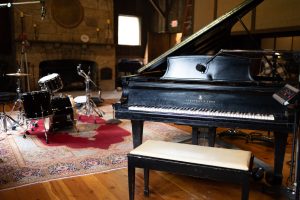
Photo by Benjamin Lehman on Unsplash
Note: All text and media on this blog are copyrighted and protected by federal copyright law.
Read it on ELENA’S SUBSTACK
BEHIND THE SCENES is a peek behind the curtain of self-producing an album. I’ll take you along on my journey as I do everything a solopreneur is required to do to create, fund and promote such a project. You can’t just create a recording and move on; no one would hear it! To get people listening to the work, promotion is required. And you can’t create a recording without funding; it is not an inexpensive venture. Join me on this adventure!
| 01. The Theme 02. The Image 03. The Web Page 04. The Music 05. The Plan 06. The Funding 07. The Key 08. The Preparation 09. The Pianist |
10. The Cover 11. The Rehearsals 12. The Recording Studio 13. The Mic Test 14. The Recording Session 15. The Instrumental Edits 16. The Vocal Overdubs 17. The Mix 18. The Demo |
19. The Rights 20. The Review 21. The Self-Recording 22. The Plateau 23. Take Three 24. I’m Still Here – Pt 1 25. I’m Still Here – Pt 2 26. Bringing a Song to Life 27. I Hear a Melody 28. The Psychology of Performance |
Typical reading time: 81 minutes
I’ve been producing musical concerts for close to twenty years now. And now, for the first time, I’m self-producing an album recording.
During the pandemic, live performances came to a halt. It came to me that I was at a time in my life to start thinking about legacy, and recording an album seemed a natural thing to do. I decided to focus on recording, rather than performance, at least for a time.
I’d done some small one-off recordings before, just a song here and there, but I hadn’t been satisfied with the results, and I knew that I really had a lot to learn about recording and how to get what I want in that environment. Unlike promotions of pop singers where you see a singer in a recording studio step up to the mic wearing headphones and start singing blissfully, it’s not quite that simple. There’s a lot to learn. This time around, I wanted to master the art and business of recording, since I expect that I’ll be doing a lot of it for the foreseeable future.
I decided to approach the production of this album as a learning experience, and it occurred to me that this might be useful to another musician, whether classical or non-classical, who wanted to learn how to approach recording with an eye toward a professional product. Singers do pop into a recording studio now to do an audition clip or two in one session, but there is so much more to recording, and it would be advantageous for any singer to learn at least the basics.
And the steps involved in this process are adaptable for self-producing any project, whether a recording, a concert, or a multi-media project, so if you’re a singer who hasn’t produced your own project before, this is a good place to start.
It also seems to me that the average non-music-making person probably has no idea what goes into creating a performance, whether live or recorded, and that that might be of interest to them. I’d like for musicians to be recognized for the hard work they put into every project.
BEHIND THE SCENES is a peak behind the curtain of self-producing an album. I’ll take you along on my journey as I do everything a solopreneur is required to do to create, fund and promote such a project. You can’t just create a recording and move on; no one would hear it! To get people listening to the work, promotion is required. And you can’t create a recording without funding; it is not an inexpensive venture. Join me on this adventure!

Any musical project begins with a theme. A musical production of any kind needs a unifying idea that allows all the elements to merge to elicit a feeling or tell a story through the music and lyrics.
Sometimes the theme comes to me suddenly, and I want to create a project that supports it. At other times, I feel an itch to create a project but the theme hasn’t appeared yet. At those times, I allow my unconscious to be with the question of what the theme might be as I go about my daily life; it usually reveals itself rather quickly. (I recommend you read my article Incubating Ideas: The Essence of Creativity and watch my video Incubating Ideas for ideas about supporting your unconscious in being helpful to you.)
I had previously produced a concert called ELEMENTS™ that focused on the environment; the programming was nature-themed music encompassing several genres. I had lots of material left from that project that didn’t make it to the concert, and it’s a topic I’m still passionate about.
As soon as I committed to recording an album instead of producing a concert, I knew that this project would also focus on nature, and it felt right to call the album ELEMENTS TWO™.
Like its sister production, this album will celebrate the elements of the Earth which, along with the many sensually rich expressions of nature, will be reflected in an album recording of jazz, Latin and American Songbook standards with just a dash of musical theater.

The image that represents the theme colors the entire project. Here’s how I approach choosing that image.
As the theme takes shape in my mind, I need a reference point, and the best reference for me is an image. I usually think in pictures, and once I have the image of the project in mind, everything flows from that. The colors, the style, the message of the image all play a role in the choice of music and the style of presentation of the project.
The image is also what will represent the project to the public. An image is more provocative than a title; pictures speak louder than words. The image gives the project’s audience an idea what the project is about on a deeper level.
The image will be used on the project’s webpage, on social media, in publications and in my Newsletter, and possibly on promotional emails or postcards. It will also appear in this project on the album cover (for a concert, it would appear on the printed program).
So the image that represents the project is really very important.
In choosing the image, I often review 200 or more images on various image-vending sites before I settle on the finalists.
If you do a web search for “free non-royalty images” you’ll see that there are many sites you might use. I currently most often use 123rf and Shutterstock, both of which are low-cost and have a good selection online, as well as the free site Unsplash. I like Shutterstock because they’re good to photographers and let them sell their images alongside some of the more well-known sources. And sometimes I find a particular photographer whose images I love, so I can always go there first and be sure to find something I want. But there are lots of affordable alternatives, both low-priced and free, that have royalty-free images with no worries about copyright.
Once you settle on a few image vendors to focus on, use search words or phrases that relate to your theme. As you surf through the images, more ideas for related words will likely come to you. I can tell you from experience that it is easy to go down the rabbit hole and spend hours on this over a period of days. So I often set a deadline for myself to make my decision for the semi-finals within a certain time frame so that I don’t spend too much time.
Focus on how the images feel to you, not whether you think they match intellectually. The images don’t have to represent your theme literally. Go with those that grab your eye and make you say “yes.”
After the initial winnowing down, you’ll want to find several images to start—but no more than, say, 10 to 15—that really speak to your theme. Sometimes you’ll feel a sense of recognition when you see them. Others you might not be totally certain about, and that’s okay.
Save all of those images that make the first cut to your computer (with watermarks, because they’re only going to be seen by you, and you don’t want to spend money on them just yet). You might want to make a digital folder for this project’s images so that you can keep all the images together. While each image site has a Lightroom, rather than jumping from site to site, you’ll want to see all the images you’ve gleaned from all sources in one place for comparison.
I use Microsoft OneNote for the final gleaning. I copy and paste all the “finalists” onto a OneNote page, print the page to pdf (saving the pdf in the image folder) and print out the result in color. I put that pdf printout on the wall or bulletin board in front of my computer; that way I can see I can see all the final images at once every time I walk by for a few days. Eventually, there’s one image that stands out to me as “the one.”
Finally, I purchase that image in jpg format in a high-resolution medium size. Now I’m ready to roll!
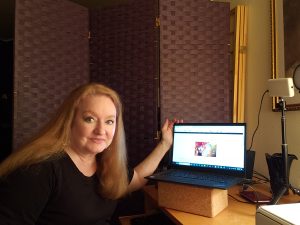
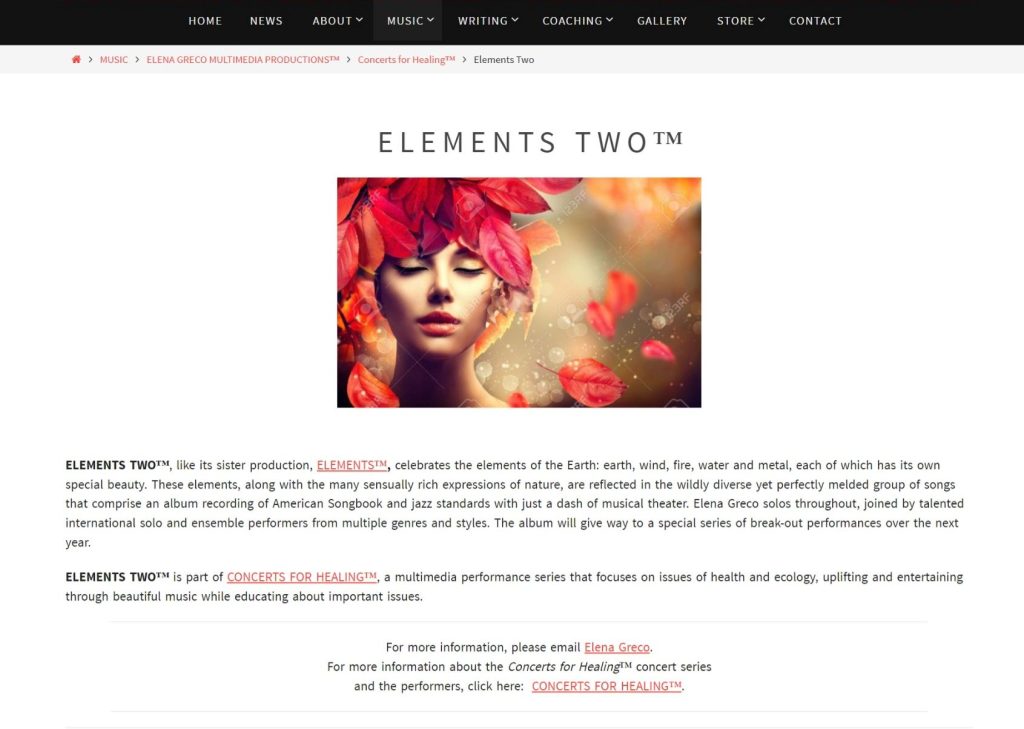
Now that the project concept “lives” in my head, it’s time to create a web page to give it a digital home. The page will initially contain only a description of the project’s theme and the project’s image. Later on, the album cover—which will be used at the website where I sell the album—and the personnel roster and bios will appear there, too, as well as a link directing the user to the place to listen to and purchase the album and relevant material.
The web page will be used initially for showing potential musicians and other collaborators to get them onboard. When I’m ready to publicize the project, it gives me a place to direct my audience to learn more.
Once I see this very public declaration of the project in this format, it helps me clarify the project further for myself, as well.
As a former webmaster for a law firm, I became handy with HTML, along with CSS and a bit of Javascript. I used that expertise to create my own website and later create websites for others. Now I just manage my own site, which is a large job and a blessing, because I use it for sharing my work with the public and as a place for all of my creative efforts to live. As a friend once said to me, “It’s you, in digital form.” My apartment is my physical home; my website is my digital home.
As a result of my past web experience, I’m able to do my own web work for my music projects. For those who are less experienced with websites, I do recommend that you learn to do your own editing and updating, even if you hire a professional to get the site up initially. It’s so easy to do now!
The basics you’ll need are a web host, use of a server, and a template to get you started on the design of your site. But you needn’t worry with all that. There are some very low-tech, easy and inexpensive solutions for getting a professional website up now which I think are quite lovely and which will take care of all three of these needs at once.
I’ve seen excellent results with Squarespace and Wix, both one-stop shops, for example, and I personally know people who are not at all comfortable with technology who have managed to create excellent websites with both of those platforms. Those providers (and probably others in the near future) offer hosting, templates, web stores, blogs and more.
You’ll want to check if the provider you choose offers a newsletter service, because that’s something you’ll definitely want now or later if you are a solopreneur of any kind. You have to keep your followers informed about what you’re doing. The same goes for a store or some means to sell things on your site, because you will almost certainly use that eventually.
I use WordPress for my own site and will likely continue to do so because I love all the plugins that WordPress offers. It’s perhaps a bit less easy to work with than the two services I mention above if you’re a beginner, but it has many benefits for those with a little basic HTML expertise.
I’m also quite fond of my Newsletter service, MailPoet, which is currently available only as a plugin for WordPress users and which also interacts with WooCommerce, a commonly used web store, which is what I use for commerce on my site, such as offering workshops or selling books or courses.
In short, if you’re creating a music project of any kind now, you need a web page on your own website, and it needs to be easy for you to access and edit yourself at the drop of a hat. Unless you’re a Big Name with thousands to spend without a care, I strongly advise you to spend a few minutes learning to edit your site, whether you choose to put up the website initially yourself or hire someone else to do it. You don’t have to ask, and wait for, someone else to add every concert, every blog post, every photo you want to add to your site. There’s just no need for that now.
If you do hire someone to create and/or design your website initially, make sure you tell them, “I want to be able to edit the site myself.” Use those exact words. The person should be accustomed to that request and will not take offense (if they do, find someone else). Ask them to show you how to access the editing feature.
As for me, I’ve finished the initial web page for Elements Two™. Have a look! Changes will follow as I add personnel and after I get the recordings up and available for purchase. Now my project has a digital home!
You can also view the page here: ELEMENTS TWO™.

After settling on a theme and title for the album, and choosing an image that represents the theme, the next step in any music project is to choose the music. This is a BIG job! In the case of ELEMENTS TWO™, there are hundreds of nature-themed songs in the popular song genre. How to choose? Listen to them all, of course!
When I began this project to determine which music might make it to the final product, I searched for nature-related music and created a private Playlist to contain the resulting 200+ songs. I’ll use this Playlist throughout the project. Then I began listening to the songs with the idea of weeding out any that I know won’t work. The complete initial search and listening took me around 8-10 hours spread over a couple of weeks. Listening to music in this way requires absorption, and I often listen to the songs in semi-darkness.
From that original 200+, I narrowed it down to 30-35 songs that seemed viable for this particular project. That gleaning process took another 5-6 hours spread over several weeks.
When I’m choosing music, I’m listening not so much for style or genre as for the meat of the song—the harmony, lyrics and emotional impact. Does this song mean something to me, and will it move the audience? Those are the questions I always ask when choosing music for a musical project.
It all starts with the songs. And I have to love them.
Now we’re getting to the part of the project that I feel passionate about! The songs are what move me, ignite me, push me to continue to the end.
At the end of this process, my Playlist contains at least one version of each of the 30+ semi-final songs. This album will have only about 20 songs (as do most concert programs), but the final cut has to wait until I’ve taken the semi-finalists for a test drive to see how they fit with my voice, my style and my soul.
Now I’m ready to try out the music! Only then can I make the final cut.

This series is about a particular project that I’m self-producing: recording an album. But many of the steps I use to produce this project are the same as those I’ve used in all of my projects over the years. And they might be useful in your projects, too, musical or otherwise.
I have a concert production schedule template that I developed years ago that serves me well for all sorts of musical projects. Most projects have a schedule of around 200-250 items from beginning to curtain. While many things about this recording project are similar to concert production, others are totally different, and I knew that there were things I didn’t even know about yet that would be required. So I’m creating a new production schedule as I go along, one specific to album recording.
Organization and planning are essential to the success of any production. You probably got drowsy just reading that sentence, didn’t you? Yes, organization is pretty much the opposite of creative. It isn’t sexy and it isn’t fun. But I make it fun for myself by seeing it as a challenge—which it certainly is. A music production is a giant mess of tasks and scheduling and problems and impossibilities … after which you have to be creative and fresh and ready to perform or direct. But I have a system!
1. My System
To start with, you have to handle a lot of information—about people, places and music. And you have to have a firm grasp of the calendar aspect of the project. Here’s how I do it.
The Intention. The intention you have for your project colors and supports everything you do in connection with it. It’s what will get you through the difficult times. Why are you doing this project? “I love to perform” is not a reason! Is there something you hope to happen as a result of presenting this concert or recording? Establish world peace? End world hunger? Your intention doesn’t have to be quite so grand. It could be “to gain exposure to people who can potentially help me get jobs at a higher level in the profession.” That’s a perfectly reasonable intention. Are you really committed to that? Will that get you through the difficult times when you’re fed up with the project? Find something meaningful about this project that you can hang on to. Once you have that, the rest is cake.
When you find your intention for the project, print it out and put it where you can see it regularly throughout the day. You can be sure that I have my intention for this recording project, along with the image that represents the project, on my bulletin board where I see it and repeat it to myself daily.
(To learn more about working powerfully with intentions, do try my Abracadabra! workshop and the corresponding Abracadabra! book)!
Macro to Micro. I’ll let you in on a secret. Whenever you want to accomplish or manage anything at all in life, always think macro to micro. Never think about details in the initial stages of planning; those are for the very last stage. Always start with the largest or most general objective. Then work down to specific goals, then sub-goals and tasks. Only in the final steps of planning will you consider details.
Often the first thing our mind does is to burden us with worries about details. Don’t listen to it! That’s one way our unconscious sabotages us. Once the larger goals are in place and in process, the details will be handled naturally. If you don’t get the Intention and the major goals clearly defined first, you won’t be successful in producing your project, whatever it might be.
Production Schedule. Every musical or theatrical project must have a production schedule. I recommend, at least at the beginning, that you use broad strokes. In order for it to be useful, you want to be able to glance at this list and grasp instantly what’s next or what’s coming without reading a lot of text. For that reason, you don’t want your production schedule to be overly detailed (while you do want your task list to be as detailed as possible).
The production schedule needs to be sortable or filterable so that you can see the various categories of information, such as different types of rehearsals or marketing tasks, at once or together. Notion does this beautifully, and I do recommend it; see the Apps section of this article to learn more. You can also use a Word table for this purpose (I don’t recommend an Excel spreadsheet, though); in that case you’ll need to have specific columns for the things you want to filter or sort. The best app is one that works well for you and that you feel comfortable using!
Music List. I keep a working database of all the pieces in a musical project, with columns for information such as song title, composer, genre, metronome markings, category (e.g., up-tempo versus ballad, art song versus aria), key, instrumentation, personnel, notes about its history, and any changes we make along the way. This database needs to be sortable, as well. This list or database will contain information about the specific thing you’re doing, whether it’s music, theater or an art showing. For a theatrical production, for example, this database might contain scenes, ensemble, props, costumes, and lights.
People and Places. You’ll need to maintain a list of the people, with their contact details, who are working on the project with you, whether musicians or technical or PR people. The list should also include places such as rehearsal studios, concert venues and recording studios. You could use a Contact folder in your email software or a Notion database for that purpose. I add any pertinent personal information that might prove useful in working with the person, as well as their birthday, their work schedule and any upcoming commitments they have that I might want to schedule around.
Deadlines and due dates. A project must run on schedule. If there’s a performance date, obviously you have to produce the show by that date. With a project that doesn’t end with a performance, such as recording this album, there are still lots of deadlines, because you’ll need to plan for a release date and a launch, and for every recording session. A calendar and a task list are required!
I use Todoist® for all project-related tasks (see below in Apps for more information). I don’t assign a due date to everything at once; I start with the first two weeks or so of work and assign dates to those tasks, and I add due dates for things that aren’t negotiable, such as a rehearsal that’s already been booked with the venue or a concert performance. So I start off with the beginning and the end scheduled. Then I start at the end and work backwards to make sure there is enough time to cover everything and pinpoint where certain milestones must be. And at the end of every week I reassess what needs to happen going forward and revise due dates.
Weekly review. I always do a weekly review of the project at the end of the week to see what transpired in the past week, how I want to create the coming week, and if adjustments are needed. If any items are past due, I assign a new due date to them; you don’t want to see a red date in the past every time you look at the schedule because that has a negative psychological effect. You’ll need to make adjustments all along the way as things change, so it’s good to have a regular time in place to catch up.
Working with others. Musicians and actors do almost all of their work with other people. This complicates things.
Every time I rehearse music, I must schedule time with at least one other person; in my case that’s usually a pianist. If we’re meeting at a rehearsal studio rather than in our own space, I must also schedule time with that studio—which is always tightly scheduled—as well as the other person—who is likely also tightly scheduled, so I have to match those two schedules with my own.
When I was working full-time at a survival job, my time was also tightly scheduled! So booking just one rehearsal with three tight schedules is already challenging. Imagine adding several other musicians to the mix! And for a concert, then there are multiple rehearsals, followed by a final rehearsal in a performance venue, followed by a performance or two or three in that performance venue. For a recording, there are multiple rehearsals, followed by multiple recording sessions. You can see how this might become a little stressful! It’s also time-consuming. Scheduling has always been one of my least favorite parts of making music.
I use a Google® Form to figure out scheduling when multiple people are involved. You can insert a few potential days and times, email a link to the form to the others involved, and they can each check which times are available for them. Then you choose the time everyone can do and inform everyone of the date … and then contact the venue or studio and hope they’re also available for booking at that time.
2. Ready for anything!
I’ve found that the way to be good at producing projects of any kind is to be flexible, adaptable and ready for anything. You need an excellent plan—one which you can expect to be broken. Repeatedly. Learn to pivot on a dime.
Know that there will be problems; that way, you won’t be surprised or stressed when they occur. See each problem as a puzzle to be solved. No need to fret. Just think of all the ways the problem might be solved, choose one and do it. After each calamity, have a good meal and a good long sleep. Then adjust whatever needs to be adjusted in the production schedule as a result of what transpired.
Focus only on the immediate next step. One of the primary reasons you do a production schedule at the beginning of the project with all the steps leading up to the end is so that you don’t have to think about all those things except at the appropriate times. Obviously, the plan will need to be reviewed and updated regularly, but in between, it’s best to focus only on the tasks (or messes) at hand.
Oh, and do back up everything regularly—apps, documents, emails, messages and media. At the end of the week, I back up anything I’ve worked on that week. That way one surprise you won’t have is losing your production schedule or your marketing materials, for example!
 3. The Apps
People frequently ask me what apps I use. Here they are! These are the apps I use and love. What suits you and your particular brain might be different. The important thing is to find what works for you and use it. Even more important is the structure I discussed above. Without that in place, apps won’t help you much.
Less is more. I find that less is more when it comes to using apps in life or production management. I tend to use apps in a fairly simple manner rather than using every advanced function possible. It’s easy to get caught up in playing with the app and lose valuable time that could be spent actually living and producing.
Laptop not phone. I also recommend, for project management, that you use all of these apps primarily on a laptop and not on a phone. The phone is much too small to give you the big picture and I find it to be ineffective for this purpose. I use the online versions, but of course you have the option of downloading the apps to any device so that you can make minor changes on the fly.
Free. I use the free versions of all the apps I use, except for a Microsoft 365® subscription. Other than the Microsoft apps, I find that the free versions have everything I need and more. Paying more money is not necessarily going to make the app more useful to you.
Learning. As with anything good in life, you have to make a little effort to get the most out of your apps. You will likely need to get accustomed to the way the apps work. If you search, for example, for “get started” and your app name, you can find many free videos on YouTube that expand on the capabilities of the apps and teach you how to do the basics. If an app is new to you, I recommend using it for at least a week before deciding whether or not it’s for you. It took me about a week to be comfortable with Todoist and a month to be really comfortable with Notion® (and I’m a former IT/applications specialist). It was well worth it!
Functions you need. It’s a good idea to list the functions you need to cover (such as those I listed above) to see where apps might help you be more effective and save time, then explore the options—which are endless! Don’t expect one app to do all of those functions; you might use two or three to handle the majority of your work.
What I use. The two apps I use the most for my music projects are: Todoist® for tasks and Notion® for information and production-related items. I keep the tasks and the production schedule in separate apps because I’ve yet to find an app that does both well. I use a few others for minor things, but those are my two workhorses.
Todoist. For actions, I use Todoist, a productivity app that’s super easy to use in a basic fashion without any fuss. This is the simplest, most straightforward task-related app I’ve found that easily accommodates the specific needs of creatives. It allows prioritizing and date/time setting (including recurring tasks) and has multiple display options. You can build on your knowledge of it as you go, but you can get started and running right away. If you’re new to productivity apps, Todoist is a great one to start with!
Notion is a genius app that I use for organization and information storage. It’s a sophisticated, yet surprisingly easy-to-use note-taking, information-gathering and organizational app that also has a marvelous database feature. It’s perhaps not as user-friendly for a novice as Todoist, but I do recommend that you get to know Notion gradually at some point because its capabilities are nothing short of transformational. It can be set up with endless configurations, but you can start very simply and add layers as you learn through the process of using the app—or not at all.
For music productions, I use a database with columns of categories that can be filtered or sorted. For example, I can set up a View that shows me only the social media posts I need to do for the project or only the rehearsals. It also has a Timeline View that I find useful in seeing my project laid out horizontally and in seeing how close I am to the finish line!
I formerly used Microsoft Word® tables for things that require sortable data or databases—e.g., a concert production schedule or a database of my blog articles. I’m starting to move many of those into Notion databases because of the helpful features Notion offers and because it’s so handy to have absolutely everything at my fingertips there. But Word tables are like an old friend, and I’ll probably be using them for a while.
Calendars. For project calendars when other people are involved (e.g., rehearsals for a music concert), I currently use Google Calendar. In those cases I usually create a separate calendar that I can toggle on/off and share with others. There are things you can do with the Calendar print function (timeline, etc.) that make it convenient for that sort of project. I suspect I’ll be researching more options in the future.
Whatever app is the easiest for you to use, takes the least time to use, and does what you need it to do is the best one to use!
So that’s The Plan, folks!

Photo by Josh Appel on Unsplash
Music does not pay for itself. That means either the producer—in this case, me—has to fund it, or the producer has to get someone else to fund it. For those who are self-producing, in some cases the funding will come in the form of grants (which means you have to know how to do grant applications or hire someone who does). Other sources are a) a fundraising platform, such as GoFundMe, b) benefactors or c) the sale of merchandise.
To fund Elements Two™, I’ve personally funded the production of a demo, which I did in a streamlined fashion to accommodate my limited budget. My plan was to use the proceeds from the sale of that demo to fund the next leg of the production.
Music is expensive to make, and no one in the music world is hit harder in the pocketbook than singers. That’s because, while other musicians are paid to do their work and don’t need to pay anyone else, a singer cannot rehearse or perform without instrumentalists, at the very least a pianist. The cost of a quality pianist is likely to be high. And for a popular singer (as opposed to classical), a couple of other instruments are usually needed to fill out the sound and represent the style.
The singer pays all of the musicians, any technical partners such as a recording engineer or videographer, and any rehearsal studio or concert hall rental. No one else pays anything. Such is the life of a singer.
In order to record this album, I will need several different pianists (since the music spans different styles), a bass player, a drummer and a guitarist. In addition to paying a pianist for regular rehearsals while I develop the music, I will need to pay the other instrumentalists. I’ll pay the recording engineer for recording, editing, mixing and mastering. And when we need to rehearse in a studio, that will be an additional cost.
I won’t shock you with the sticker price of this very bare-bones demo, which is my first serious attempt at recording. Just know that it’s not insubstantial and is in fact quite substantial for someone like me who lives on a fixed income.
So it is my sincere hope that you purchase the songs I’ll be offering shortly on Bandcamp, and that you enjoy the songs immensely, since that is the point of the recording!
It is also my hope that you pass on the link to buy the songs to others to help me expand my reach. That will ensure that I can prepare and record the next four songs. I will be humbly grateful!
As a minder of what the album recording is all about … the music of the ELEMENTS TWO™ album celebrates the elements of the Earth—earth, wind, fire, water and metal, each of which has its own special beauty—reflected in the wildly diverse yet perfectly melded group of songs that comprise an album recording of American Songbook and jazz standards, including Latin favorites, with just a dash of musical theater. The album is part of CONCERTS FOR HEALING™, a multimedia series that focuses on issues of health and ecology, uplifting and entertaining through beautiful music while educating about important issues.
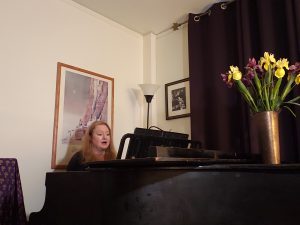
All this work, and we haven’t even gotten to the music yet! Not to worry. Now begins the musical part of the journey! And of course we begin with the heart of the project, the songs.
The first step in singing a song is to choose the key. This often takes a little work.
I use a rudimentary approach to get started. Sitting at my desk, I start singing the song, then go to the piano to see what key I grabbed. About 95% of the time, that’s the key for me! My unconscious seems to do a better job of choosing the key than my highly-trained brain. Otherwise, I take a look at the sheet music online and choose what looks to me to be a fit with my voice and print a copy in that key (or upload to a tablet). Then I take it to the piano and see how it feels to sing it and how the timbre of the voice in that key suits the song (more about that below). I might find that it needs to a half step go up or down. We’re fortunate that we can find almost any song in almost any key online now! I used to have to convert most of the songs I sang and then transpose them using PhotoScore software, a time-consuming effort.
The key is really a very important issue in delivering a song effectively. It doesn’t just need to fit your voice; it needs to fit the song.
The key in which we choose to sing a song is part of our artistic expression. A song tells a short story, and how well we tell the story, using all of the musical choices at our disposal, defines us as artists. One of those choices is the key.
A song in any genre of popular music, as well as classical art song, can be sung in any key in which you chose to sing it. You’re not limited to the key in which the sheet music happens to be written or the key in which the composer wrote it.
With this choice, comes questions: Which key? How do I choose? Why this key rather than another key? Why, other than vocal comfort, does the key matter?
These are important questions. They go to the heart of vocal music.
An opera aria, contrast to more popular song, is written to be sung by a specific character and vocal type with a multi-instrument orchestra and other singers. The composer wrote it exactly the way s/he intended it to be sung, right down to the dynamics, the tempo and the way s/he wanted the words expressed. The key of an opera aria (usually) cannot be changed, even if performed with piano instead of orchestra, because the composer wrote the vocal line to express the lyric, not only in terms of pitch but in where the vocal line lies in the voice. For example, pitches that lie on the passaggio naturally have more tension and angst. Changing the key would diminish that effect, which might diminish the aria, since there is a dramatic story to be told. And of course there are all those orchestra parts to consider!
Popular song and art song, on the other hand, are much freer in the choices they offer, not only in their artistic expression but in their key.
In popular music, the composer or songwriter sometimes writes with a particular singer (or themselves) in mind and chooses a key comfortable for that voice. That does not mean that you’re conflicting with the composer’s intention when you choose a key that works for your particular voice and expresses the lyric in the best way that you can. Composers of popular music and art song usually expect that their songs will be transposed.
Choosing the key. So how do we know which key is the one? you might ask.
First, study the lyric.
Allow yourself to feel the emotion of the song’s lyrics and note how the music expresses that emotion. Is it sad, angry, happy, superficial, deep, lonely, loving, dramatic? A sad lyric, for example, would not encourage you to sing high in your range or above the passaggio. Instead, you might choose a relatively low key to best color the sad lyrics. A dramatic one might do the opposite and beg that you sing in the upper reaches.
Second, study the music.
Do the highs and lows of the vocal line create an effect that paints the lyric, or are they just a part of a nice melody? Did the composer write the music generally low or generally high? What might that mean? For example, s/he might have chosen a relatively low key to express sadness, or s/he might have chosen a higher key to express happiness or triumph or insanity. Which is it? Answers to these questions to can be found in the harmony and the vocal line that the composer used, as well as in the lyric.
Third, think of how those things apply to your own instrument.
Is your voice, for example, naturally warm in the lower middle, bright and ringing in the top, thunderous in the lower part? You can use those attributes to paint the lyric by choosing a key that accentuates the quality that best expresses the feeling of the lyric and music.
Also, consider how even the most minute adjustment can change the color of the entire song. If you sing a song a half-step lower or a half-step higher, the overall color of the voice and the emotional effect of the song will be completely different. Once you think you’ve chosen the key, try it a half-step up and then down to see which of the three keys expresses the song the best. Record it and listen to the difference. You might be surprised.
This might lead you to other questions: “This is the best key in my voice to express this song … but that high note lies right on my passaggio! Might I take it down a half step, which would make it easier?” You might, but you might also find that doing so changes the overall color of the song in its entirety and doesn’t work as well for the song. The song isn’t about one note.
You want to find the key that expresses the song and reaches the audience, making them feel the meaning of the song on a visceral level.
Getting the sheet music in your key. Once you find your key, you’ll want to get a copy of the sheet music in that key. Transposition was once an arduous and sometimes expensive undertaking. Now it’s a breeze.
Check out MusicNotes and SheetMusicDirect online. They have automatic transposition available for most of their popular songs. If, once you find your song, you choose a key and purchase the song, then find that you need a different key, you can download or print a copy in the new key at no charge. So there’s no work at all for you to do!
But if you do need to transpose it yourself because you can’t find your key online, don’t worry. I used PhotoScore for that purpose for years and found it to be an easy-to-use and easy-to-learn software for transposition purposes.
Test the key. There’s more! After I choose the key for a song, the next step is to run through the song with a pianist. At that point I often find that I need to take it up a half step or a whole step. That’s because singing over a piano requires a little more intensity and support than singing alone in my living room. A key that suited me just fine singing alone in my living room sometimes feels too low when I sing with a piano.
Once I’ve had the run-through with piano, I know for certain which key I’ll use. Then I get the new key, if need be, and print two copies for the books (binders) I create for the pianist and myself.
And then I do that process for all twenty songs! I do like to choose the keys for all the songs in a project and print sheet music for them at the beginning of the work on the project. I find that stopping to do this key-finding, sheet-music-finding and printing every time I begin work on another song in the project interrupts the flow. I like to keep the momentum going.
I do this process for all the songs in the project, then move on to the next step. Can you guess what that might be?

Photo by Kati Hoehl on Unsplash
Now that I’ve made the initial song choices and I’ve tentatively chosen a key for each song, it’s time to make some music!
But not so fast! In order to begin working on the songs with a pianist and developing my own cover, I have to put together a “book.” The book is a three-ring binder for the project in which there’s a copy of the sheet music for each song and its lyrics, labeled for easy location. Initially there are two books, one for the singer (me) and one for the pianist. Later there might be others for additional instrumentalists or singers.
The first order of business is to a) print the sheet music or chart for each song twice, three-hole punched and double-sided, b) print the song lyric sheets twice, c) create and print two labels for the song, d) put the labels on reusable tags which will be attached to the first page of each song, and e) put the songs in the book, initially in alphabetical order, later in order of the sets. If we’re starting with 30 songs, that means 60 printouts of double-sided, three-hole punched sheet music, 60 printouts of lyric sheets, 60 labels printed and attached to tags, and 60 tags attached to the sheet music. As you can guess, this takes a while.
At the end of this process, I’ll have two books, each containing all of the labeled songs and their lyric sheets, and each book labeled clearly for the vocalist and the pianist so that we don’t confuse them (because we each do different things with our books).
I should mention that some people use an iPad or other tablet, together with certain software and hardware, in place of hard-copy sheet music now. Although it can be convenient to carry a tablet rather than a binder of sheet music, I haven’t found it to be useful for the way that a pianist and I work with music yet, and every pianist I’ve worked with so far strongly prefers to play from and write on a hard copy of sheet music. So while I like the idea of using a digital copy, I haven’t found it useful in real life just yet. There’s also the small issue of the battery running out in a performance. I do of course keep my sheet music library in pdf format on my computer and in the cloud, but until there are further improvements in using digital music in rehearsal and performance, I’ll stick to my hard-copy binders for working on or performing the music.
Not terribly glamorous, eh? The public sees musicians only when they’re performing. The work that takes place behind the scenes in order to get to the performing stage or recording studio is often tedious and demanding.
Now it’s time to try out the songs with a pianist so that the key can be finalized and the initial work on the song can begin.
In order to perform, a singer needs an instrumental collaborator, and that collaborator is almost always a pianist. Depending on the music, other instrumentalists might be required, but the singer-pianist relationship is the primary one in almost any vocal endeavor.
Because it is a relationship, albeit a professional one, the singer and pianist must be compatible in spirit and artistry. That means some careful research and testing must take place on the part of the singer in order to find a good match.
There are as many types of pianists as there are singers. There’s a division between classical and popular music, of course, but there is further subcategorization in each category, and even further subcategorization beyond that. A pianist who excels at jazz might not be adept at musical theater or folk music, for example, and a pianist who specializes in early jazz might not be comfortable with fusion.
Beyond personal compatibility and the matching of musical type is something harder to define, which I’ll call “approach.” My own approach to a song is that it’s a story that is told through the lyrics, and the harmony and melody paint that story harmonically and lyrically. I need for the piano part to support all of that, in addition to supporting me as a singer by following my breathing and phrasing—that is, the way that I choose to accentuate certain words or to group phrases in order to tell the story. A seasoned pianist picks up on the singer’s style and breathing quickly, and enhances and supports what they do, rather than getting in their way (which makes my job so much harder!).
Some of the pianists within my current focus of jazz standards, musical theater and cabaret are also musical theater conductors or music directors (MDs) of cabaret shows, so they might want to take a larger role in the artistic development of the song than would a pianist who is solely an accompanist. And when that’s the case, I want to take advantage of what they have to offer, so I appreciate their input about the interpretation of a song. But I’m still the one who’s singing the song, with all eyes and ears upon me, so ultimately the arrangement and accompaniment have to fit my interpretation so that my effort is successful.
Eventually, through rehearsals, the singer and pianist become comfortable with each other so that making music becomes a true partnership.
An ideal collaboration is one in which the singer and the pianist each contribute synergistically to making the song a work of art—and of course to making the singer sound their best!
In this recording project, the next step for me was to choose the first two songs to record. That’s because most recording engineers insist on a minimum session of two to three hours for laying the initial tracks of a recording, so you need enough material to fill that time. In addition, there needs to be some break time built into the session. I find that two songs is just the right amount of music for a two-hour recording session. That’s enough time to record each song several times through, and to record an extra take or two for select bits.
I chose for the first recording in this project two songs in the jazz standard category. Because I’m not essentially a “jazz singer,” but rather a singer who tells a story through song, for these songs I needed a pianist who could support that in the way that someone who plays musical theater or cabaret might, but also could move easily into the jazz realm stylistically and harmonically.
I came up with a list of several pianists by getting referrals from people in the business and by checking out the accounts of certain of my Facebook Friends who sing that type of music to see who their pianist friends were. For everyone on my list, I searched online for websites and YouTube videos. I listened to and read about each pianist. I marked off any of those who didn’t seem a good fit for my musical style or for those particular songs. I located contact information for the ones remaining and wrote an email to them that briefly laid out details of my recording project, who had referred me to them or how I found them, and when I would need to work with them (a sort of who-what-when). Then I waited.
I have to say that at this point in time I don’t try to engage anyone for whom I can’t locate an email address. I just don’t have the time to try to do business on the phone because it takes too much time, and I can’t express myself on the phone as well as I do in writing. Most of all, it makes things easy for both parties to have all the information in writing to refer to, and to be able to respond when it’s convenient.
For the pianists who responded to my inquiry, I set up a trial session. The trial session is really a trial for both parties. I’m the one who does the hiring, of course, but it’s also up to the pianist whether, after running through a few songs with me, they feel they would enjoy working with me. If either of us is not convinced it’s a good match, then I mark them off the list and move on to the next pianist. There are no hard feelings on either side, because this is a business transaction at this point.
If one of the remaining pianists doesn’t jump out at me as “the one,” or if they all seem wonderful and I can’t decide, then I have another session with each of them, and work a little more deeply on the songs. Then I make a choice for that part of the project. The ones remaining on the list I will surely work with in the future.
For the first two jazz standards of the Elements Two projects, I chose a pianist who was not only an accomplished accompanist to major singers in musical theater and cabaret but a Broadway conductor. He was totally comfortable with jazz standards and we seemed to be a good fit.
These first two songs also required a bass player. This is a different sort of musical relationship, because the bass player tends to come in later in the project, after the singer and pianist have finalized their arrangement. I followed a similar procedure to that above for finding just the right bass player for the songs, but I didn’t have a trial session because the bassist had previously worked with the pianist and with several other people I knew, and I believed that he was not only reliable but had the musicality and professionalism to do the job with minimal rehearsal. I was right!
The rest of the Elements Two project will require several other types of pianists, along with several other instrumentalists. I’ll follow the same procedure for all of the songs’ instrumental requirements.
At the end of the “choosing” process, the real musical work begins!
Note: For an in-depth exploration of the relationship between singer and pianist, and the requirements for a successful artistic collaboration, you might want to read my book VOCAL COLLABORATORS. It’s specifically about classical accompanists and singers, but much of the information is highly relevant to other genres, as well.

I’m making progress with my recording project: I’ve chosen the music, I have sheet music in potential keys for that music, and I have a pianist. Time to start making music!
In order to sing or record a song, I need to develop my own cover. (A cover is an interpretation of a song that has already been recorded by someone else.) That means that I give the song a unique interpretation that makes it mine. How I choose to express the lyric, which melodic embellishments I choose, whether I sing the song in its original tempo or a different one, the dynamics I choose, and the general musical style I employ all play a role in creating my artistic statement as I bring the song to life.
In developing a song, I first listen to a multitude of covers of that song, as well as the original version. I choose the covers that resonate with me in some way, no matter how small, and pop them into a playlist.
For each song, after listening to the covers multiple times, I begin to choose the elements of those covers that I might want to incorporate into my own interpretation, such as certain melodic licks (improvisations on the melody), unexpected harmonies, and phrasing choices (how the lyric is expressed and where breaths occur).
I use both sheet music and a lyric sheet (a typewritten printout of the lyrics only, with no musical notation). I tend to make my notations about interpretation on the lyric sheet. At the end of the process, I might make a few changes to the sheet music, but for me, the focus is always on the lyrics, and using the lyric sheet simplifies things and really works for me.
Then I sit down at the piano and take the song for a spin in the key I’ve tentatively chosen. First I sing it exactly as the music indicates. Then I use my notations on the lyric sheet to try different variations on the melody and phrasing to determine what feels organic and natural to me. I repeat this quite a few times until I have what seems to be the way I want to deliver the song. I repeat that version a few times to fine tune it as more ideas come to me. Eventually I arrive at a semi-final version that is ready to run through with the pianist. I mark any necessary musical changes in the sheet music that I’ll offer to the pianist and finalize my lyric sheet.
This is by no means a final product! As I develop the song along with the pianist, many things could change. And the more I sing the song, the more I begin to make it my own, so that my interpretation continues to evolve until it feels complete. Then when I sing the song, it’s an authentic communication from me, and I can put my heart and soul into it.
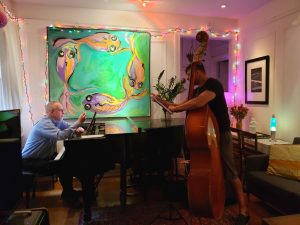
Bruce Barnes, piano, and Matt Scharfglass, bass
hard at work rehearsing with me for an Elements Two recording
Now we come to the most important part of any musical project: the rehearsals.
First are the rehearsals I have with piano alone. I bring the pianist the book I’ve prepared of the songs; it contains sheet music in my chosen keys with any structural changes I’ve decided in advance that I want to make and a lyric sheet that reflects the lyrics as I’ve chosen to sing them (I sometimes rearrange the order of stanzas or very slightly alter the lyrics to fit my interpretation).
The first time we run through the songs, the pianist is sight-reading unless the song is one they already know. Even if they’re familiar with the song, they might not have played it in my key or my particular arrangement. And this is the first time I’m singing the song with another person, so both of us are finding our way with the music, not terribly worried about doing it perfectly or bringing interpretation in just yet. After that initial run-through we begin to explore the music freely and make musical and interpretative choices
The first two songs I chose to prepare and record for the Elements Two project were Come Rain or Come Shine and Stormy Weather. In doing my research and listening to covers, I discovered a section in Stormy Weather, currently omitted from the song, which is heard in only one or two covers from the 1930s and 1940s; I found it to be an incredibly important addition, one which was in the composer’s original score. (That’s another reason I listen to many covers from all periods and styles before I begin to interpret a song; you never know what you’ll find!) I couldn’t find sheet music anywhere that contained that section, so I pulled the score that I did have into PhotoScore and cleaned it up. Then I created that section in PhotoScore separately, note by note, and then added it to the original score in the place that I felt it worked to convey the story of the song. While time-consuming, it was well worth the effort to arrive at my own unique arrangement that expressed the lyric so beautifully and showed the song in its original richness.
Every time the pianist and I run through a portion of the song we’re developing, we each share any interpretive ideas that arise, and if we’re in agreement, we notate the changes by hand in the sheet music. After several (or many) more rehearsals, our arrangement is almost set. At that point, if there are substantial changes in the sheet music with regard to harmony or structure that we’ve agreed on, I pull the music into PhotoScore, clean up the score and make the changes, then pdf and print the sheet music for both of us again so that our scores reflect our own arrangement. That way we don’t depend on hard copies that could be destroyed or lost, losing all our hard work (voice of experience). I make certain interpretive notes in my own lyric sheet and reprint that, as well.
Once we agree on any final musical changes and I’ve edited and reprinted the music for the final time, I continue to build my version of the song interpretively with regard to my own performance.
Then it’s just a matter of running through the song a number of times to let our interpretation continue to reveal itself and to let the kinesthetic memory in our bodies develop so that the song becomes organic. It’s only then that we can really perform the song.
At that point, it’s important to me that there are no more harmonic or structural changes to the instrumental music so that I have a solid foundation on which to perform. That allows me the freedom to go with my instinct and find unexpected nuance and detail. I can’t do that if things continue to change under me unexpectedly.
Once the pianist and I have become comfortable with our final interpretation of the song, including harmony, lyrics, structure and artistic interpretation, we’re ready to add any further instrumentation we’ve agreed on that might enhance our cover.
In the case of the first two songs I chose to record, I wanted a beat, but not the sharp percussiveness of drums, and the songs required a bit of depth. I chose to use a bass to provide the rhythm and color I wanted.
I hired a well-regarded bass player, who indicated that he was fine with only one rehearsal with the pianist and me prior to joining us in the recording studio. Because I had marked the music well and could give him clear guidance, and because he was highly recommended, I felt comfortable with that. He was totally professional and played like a dream with minimal direction, both in rehearsal and in the recording session. I wish all musicians were this easy to work with!
Next up? A trip to the recording studio!
Note: For an in-depth exploration of the relationship between singer and pianist, and of what contributes to a successful artistic collaboration, you might want to read my book VOCAL COLLABORATORS. It’s specifically about classical accompanists and singers, but much of the information is highly relevant to non-classical genres, as well.
Now that the first two songs were close to being ready to perform, I began my search for a recording studio.
It was a long search! Most recording studios in Manhattan, where I live, are insanely expensive, far beyond what my meager budget could accommodate. Since I’m a self-producing solo artist, as opposed to a musician who’s represented by a recording company with unlimited resources, my first objective was to find a studio that would offer me an affordable rate.
In addition, after having some brief recording experiences earlier in my career, I knew that it was important to find a studio where I felt comfortable and an engineer who not only understood what I was looking for in terms of sound, but was pleasant to work with.
Many years ago I did a couple of simple recordings, and while the engineer at one of the studios I used was excellent in many regards, he had some personal issues that not only made it unpleasant and stressful to work with him, but caused some problems with the recordings that resulted in wasted time and money for me. So I knew that I wanted someone who was steady, pleasant and reliable this time.
And it would be a plus if the studio did not require a long or complex trip to get there from my home. Although I was starting with a two-song demo, I planned to continue recording regularly for the next year until I finished the album, so it needed to be a place I could access easily on a regular basis. I have a health issue that makes subway travel particularly challenging, so I wanted to limit the trip to one train if at all possible.
I first got recommendations from a few colleagues and researched the studios online to see about location and reputation. A couple were simply too far for me to travel more than once. One studio that came highly recommended by an experienced musician was a short, easy trip from my home (I could even afford to take a cab!), and their website showed images of an inviting-looking studio and some impressive credits, so I started there.
Unfortunately, their rate was more than double what I could afford to pay! When I explained that to the representative, she came down a bit on the price, but the rate was still too high for my budget.
Finally I found a studio, recommended by several colleagues, that had a reasonable rate. It was a bit of a journey, but it was possible to get there using only one train, so I figured I could make it work.
I told the engineer who owned the studio that I wanted to record an album of standards and that I wanted to find a studio to call home for the time it took me to make it. I said that financial realities dictated that I start first with a demo of two songs, which I would post to Bandcamp to raise a little funding to record more. I wanted him to know up front that I might have to do it in small spurts, rather than in a few long sessions, but that I was committed to working with the right studio long-term.
He was a pleasant chap who seemed to be used to the ways of singers (we’re a different sort) and to have all the requisite skills. I felt comfortable going forward with his studio.
Next, I set up a time to have a mic test with him before I brought in the pianist and bassist to begin recording.
Photo by Los Muertos Crew on Pexels
The microphone the singer uses in the recording studio is possibly the most important thing about the recording. That’s because the microphone determines the sound and timbre of the voice in the recording, and it can make the singer sound better or worse than they do in real life. Obviously, I want to sound better and not worse!
Through the unfortunate recording experience earlier in my life that I mentioned in The Recording Studio, I had learned the hard way that having a mic test to choose the right microphone for the project is essential.
In that past experience, as someone who was totally new to recording, I had recorded overdubs on several different days. The vocal tracks I received from the engineer clearly had a different sound on each of the days. I liked the ones from one of the days much more than the others, so I asked the engineer what the difference was and if he could make them all sound like that. He insisted they all sounded the same. As a musician with a finely tuned ear, I knew that they did not. Long (very long) story short, he had used a different mic for each of the days that I did overdubs on the same song, ensuring that the sound would not match. That meant that when I tried to choose bits from each track to knit into a final recording, I was unable to do so because they did not match.
The whole purpose of doing overdubs is so that you have multiple tracks from which to choose pieces to knit together (assuming you aren’t a superhuman who gets everything perfect the first take). The sound in all the overdubs must match, or you cannot do that. You must therefore use the same mic for all overdubs for the same song. So in that past experience I had spent time and money coming in to do overdubs, and it was all wasted because he had not used the same mic. I have no idea why he did that, although I have a hunch it was because he tended to be disorganized and he likely didn’t make a notation of which mic he had used originally. And he had never offered me a mic test so that I could choose the sound to begin with. Lesson learned!
In a recent trial of a recording studio, before I found the one I settled on, I asked for a mic test. The engineer responded in the negative, saying that he knew what worked. And did it not matter to him what the customer wanted, or did he only want to please himself? And given that he hadn’t yet heard my voice and that I hadn’t told him the sound I was looking for, I knew that his lack of accommodation was probably a bad omen (which unfortunately was the case). I went ahead with one small recording there, because a friend had introduced us and I felt an obligation, but it was not successful, so I moved on and continued searching for a studio until I found the one I ultimately used for the demo.
When I did my mic test at that recording studio, the engineer suggested two mics to try first. One of the mics I had used in the past, the Neumann 87, and had found that it worked well for my voice in classical music, so I just needed to be sure it worked for my voice in popular music, as well. After I tested both mics by singing a bit with each, the engineer suggested we try one other, the Neumann 89. I went away with recordings of three mics to choose from.
I found it difficult, as I always do, to evaluate the voice in the clips. I’m not at all fond of listening to myself (it’s excruciating, if you want to know the truth, because I hear everything that’s wrong with it and not much that’s right), so listening to the mic tests already seemed like a less than pleasant task. I persevered and did my best to evaluate the sound objectively compared with the sound I was looking for.
I leaned toward the Neumann 87, but the Neumann 89 offered more depth, maybe a slightly richer sound albeit a darker one, which, although not my usual preference, I thought might be a good thing in the bluesy jazz standards I was planning to record first. I had a very hard time deciding, but finally decided to go with the Neumann 89 for the recording session.
Next up? It’s time to bring the pianist and bassist to the studio with me to lay the tracks for the demo and start recording!
Photo by Benjamin Lehman on Unsplash
And now comes the point of the whole adventure: recording! Now that I’d prepared a couple of songs with the pianist and the bassist, chosen a recording studio and a mic, and scheduled a time that worked for all parties, I was ready to lay the first tracks.
I mentioned previously that I have a health condition that makes travel a little tricky. I didn’t mention that I also have asthma, which is challenging for a singer since it affects the breath, which is the carrier of the vocal sound. I’m not the only one who is so afflicted (Bernadette Peters, Billy Joel and Dolora Zajick are asthma sufferers), but it’s something I always have to deal with and plan for. I’m careful not to expose myself to anything I know I’m allergic to or to dusty or polluted air in the twenty-four hours before I have to rehearse or perform.
Now came the day we were all set to record in a Soho recording studio. Soho is downtown from my Upper West Side home, and that of the pianist. If you’re not from Manhattan, just know that that’s quite a distance, and that it’s a different area that generally has a bit more air pollution than we have on the Upper West Side, which is farther north. That’s because Soho is sandwiched between Downtown and Midtown, the two business districts of Manhattan.
But the studio itself had air purifiers, and I figured the trip down on the train was brief enough that it wouldn’t cause a problem. I had gotten a respiratory virus about ten days before the recording, the worst case for a singer, and I was of course concerned about the effect on my voice, because in a recording, sound is everything; there is nothing else. However, my primary objective for the session was to get the instrumental tracks done, because I could always go back and do vocal overdubs. That reduced the pressure a bit. I much prefer a live performance, though, and wanted to get the vocals down, too, if at all possible.
I had a final rehearsal on the recording project two days prior to the recording session. Although I was still a little sick, it went well, and the voice was coming around, so I felt fine to go into the studio.
Then … the Apocalypse came. On recording day, I woke up to a sky that was ORANGE. The Canadian wildfires were out of control, and heavy smoke was drifting south over New York. By 1:00 p.m., it was so dark I had to turn on all the lights as if it were night. You couldn’t see anything outside through the thick haze. The air quality, on a scale of 0-500, was 485. We were warned not to go outdoors. Did I mention I have asthma?!? I was not about to cancel the session, though, because my pianist was going out of town for an extended period, and because booking two musicians and a recording studio at a mutually acceptable time again was something I didn’t want to do, plus I was already behind schedule.
So I went. I did it. I had no breath, but the only thing that was crucial was to get the instrumentals down. I could go back in a couple of weeks to re-do the vocals alone.
I walked out into a scene from a movie. Orange sky, no visibility, people stumbling around with a dazed expression. I put on a mask in the hope that filtering the thick, polluted air would stave off asthmatic symptoms until I got to the studio.
When I arrived, the recording engineer said that every other singer he had scheduled for that day had cancelled. No one could sing in that environment.
But sing I did. And I have to give major kudos to the pianist and the bassist for showing up that day, as well. We were all committed to thumbing our nose at Mother Nature and getting the job done. In addition, the instrumentalists were seasoned pros, and weren’t likely to cancel under any circumstances, because that’s what musicians do: the show must go on.
After everyone arrived at the recording studio, we settled in for our two-hour session. It was the first time I’d been in the booth in that particular studio. The booth is a tiny, soundproofed closet that allows a singer to record isolated vocals on a separate track while the instrumentalists play in the same studio. I’m never crazy about singing in a small space, but it’s a necessary part of the recording process if you’re recording other tracks simultaneously. It was difficult to find a place to stand or sit in this particular booth that was comfortable, but I managed to find a spot I could maintain for most of the two hours we were there. The headphones through which the instrumentals were fed to me were far too large for me, and I had to use one hand to hold them on while I sang, which made singing difficult. I’m never one to complain in a performing situation, though, and I wasn’t the important one on that particular day, so I just muscled on through and got it done.
The instrumentalists were troupers, gave it their all, and got some terrific instrumental tracks down. The recording engineer was pleasant and helpful, and I felt we were in good hands. All in all, in spite of the Apocalypse, the asthma, the respiratory virus, and the headphones, the music-making was productive.
With a two-hour session that’s focused on executing the music as perfectly as possible on a recording, as opposed to performing the music for an audience, the concentration required is intense, so it’s important to take breaks. The energy in performing radiates outward, while in recording, it goes solely into the microphone. Taking a break not only gives our minds and bodies a rest, but we come back with a renewed focus and a clearer ear.
In addition to a couple of short breaks, I called a major break halfway through. We had a chance to leave the recording studio to sit in the outside room, walk around, have a nosh or a drink, and talk. The recording engineer offered to play tracks for anyone who wanted a listen at that point. The pianist wanted to hear a couple of tracks, but I avoided listening at all, as I know that listening to my own singing is often traumatic. I wanted to keep my focus on the task at hand and to replenish my energy.
During the recording session, it’s important to keep everything as positive and relaxed as possible. That’s good practice for producing or directing virtually anything in the music business, but it’s especially essential for recording, as the experience is so condensed in every regard.
I felt certain that we had had a productive session, and as we concluded, I let the instrumentalists and the recording engineer know how very much I appreciated their work. Then I walked out into the Apocalypse once again. This time I didn’t bother putting on the mask, inhaling quite a lot of the polluted air … something I came to regret.
The next day I woke up coughing up soot! I couldn’t breathe. I hurt all over. I was sick with asthma and exhaustion and didn’t make it out of bed all day. Lesson learned. In the event of another Apocalypse, wear a mask at all times!
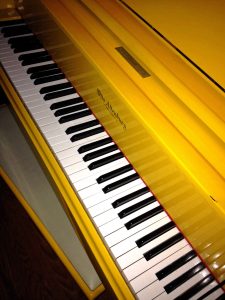
Chip Fabrizi’s beautiful yellow piano at PPI Recording
Now that we’d finished the first recording session, and the instrumental tracks were done, I needed to use them to create a seamless backdrop for the vocals I would re-record. That meant that I had to edit the instrumental tracks.
This is the part of recording that I truly despise: editing. Editing a recording means listening over and over the individual tracks of a song to glean the best bits of each of them to knit into a final track. Going through the entire song, you must notate which part of which track you want to use, notating the minutes and seconds of the tracks so that the recording engineer can understand exactly what you want. For example, 00:21‑01:02 means going from the starting point of twenty-one seconds into a specific track through one minute two seconds in that track. The final editing result goes something like this: track 1, 0:00‑0:12; track 3, 0:13‑0:16; track 2, 0:17‑0:22; track 4, 0:23‑0:28; and so on, for the full three or four minutes of the song.
It’s a tedious, time-consuming process.
In this case, I was fortunate that I had only one instrumental track for each take, meaning piano and bass were already together. They were recorded in the same room, but with the bass isolated, so although I could have asked for the bass track separately at some specific point if need be, that fortunately was not necessary. Still, it was a monumental task.
I had to listen to three or four tracks each for a three-minute song and a five-minute song, comparing each track to the others and making decisions on which portions of which tracks I wanted to use. Eventually, after four or five hour-long stints over several days, I came to my final choices and sent the result to the recording engineer.
He sent me a first edit for review, and once I signed off on it, he sent me a final instrumental track to practice to in preparation for the vocal overdubs I would do later.
My next task was to get myself comfortable with singing to the instrumental track.
Singing to a track, rather than with live musicians, is not comfortable for me. I’m used to a pianist following me when I perform; when singing to a track, I have to match my singing to what someone else has already played, which is the exact opposite. That requires that I know the instrumental track well enough that I can hear it in my head and not have to focus too intently on listening to it in real time while I’m singing, since that would pull me away from my interpretation of the song.
Once I felt (sort of) comfortable with performing to the instrumental track, I set up a session for re-doing my vocals in the studio.

Photo by Los Muertos Crew on Pexels
We’ve reached the final stage in recording the tracks: doing the vocal overdubs. These are the vocal tracks that will be added to the instrumental tracks. Once all of the tracks for all instruments and voices are laid, or recorded, we’ve truly begun the recording process, which is much more than recording the sound.
Now that I had edited the instrumental tracks, it was time to record the vocals.
Doing vocal overdubs is not the most comfortable process for me, as I mentioned in the last segment, since I have to fit my singing to a previously recorded instrumental track, rather than singing freely, knowing that the instrumentalists will follow me, as they do in performance. This restricts my artistry a bit. I assume that I’ll become more comfortable with that process over time.
Recording overdubs to a previously recorded instrumental track, rather than recording the vocals live at the same time the instrumentals are being recorded, means that I don’t have to sing in the isolation booth, which is a great relief to me. First, I’m a bit (okay, a lot) claustrophobic, so being in a closet-sized room is not particularly comfortable. In addition, I have a large vocal instrument, and singing in a small space makes me feel that I have to scale my sound down, which is something I don’t want to do. Third, I don’t get the feedback or reverberation in the sound in an isolation booth that I get in a larger, more resonant room. I want to be able to sing freely and expressively, and that’s something I do much more easily in an open studio than in the booth.
To do the vocals, I had to become accustomed to singing with the instrumentals coming through headphones, rather than hearing them live. This might seem like a small thing, but it really does change how the brain and the ears process the sound. I have for years performed live and acoustically, so getting used to the electronic way of making music is a major change.
I had two songs to record and needed to fit my overdubs into one hour of recording time. I chose to alternate laying tracks for one song with the other song so that I didn’t do all of one song when I was fresh and the other song when I was tired. I recorded a couple of takes of Come Rain or Come Shine, then a couple of takes of Stormy Weather, then took a very short break. After that I laid another full track of each song. Then I did chose just a few measures from each song for which I wanted to be sure that I’d gotten what I wanted, or which was a tricky or difficult spot.
Once I was finished, the recording engineer asked if I wanted to hear the tracks. I once again declined, since listening to myself is uncomfortable, and I wanted to do that in privacy at a time I could listen to them while wearing my producer hat rather than my singer hat. I can be more objective and less self-judgmental when I’m approaching the listening as a producer’s job rather than as a musical artist.
So now all the recording for this segment of the project was done!

Photo by Adi Golstein on Unsplash
Next up in my recording saga is the mixing. In the recording process, mixing is like combining ingredients into a new dish: a little of this, a dash of that, add some more of the other thing, and presto! You have a delicious meal. Or do you?
In the case of my simple recording (“simple” compared to others’ recordings, not simple for me!), we had now laid the tracks for the instrumentals and the vocal, and it was time to mix them together into a final product.
First, though, I had to edit the vocals in the same way that I edited the instrumentals (see #15 The Instrumental Edits). Once I’d sent my edits on the vocal tracks to the engineer and he’d processed them, we were ready to do the mixing.
Mixing in this case meant combining the instrumental and vocal tracks, then making adjustments as needed in balance and technical specifics.
The engineer said that he would like me to come to his studio to do the mixing with him. I was not totally comfortable with that, since I don’t like making important decisions of that sort on the spot, preferring to listen and ponder over the course of several days before making final determinations. In addition, I have a bit of trouble hearing and making aural decisions in an environment I’m not used to. But I figured the engineer had good reason for asking me, so I obliged.
That turned out to be a mistake, but I couldn’t know that until I tried it. Previously, I had always left the mixing up to the engineer. Then if anything seemed off, I would request a specific tweak or two to the mix.
Sitting in that particular control room (the room where the mixing console and computers live, the heart of the recording process), I found that I was unable to hear accurately. I wasn’t sure if that was due to my hearing or to the acoustics, but there was nothing that could be done about either, so I just did the best I could. The treble—in this case, the vocal—seemed inordinately loud, so when the engineer asked me if I wanted to bump up the vocal, I said no (a mistake, it turned out).
I had asked the engineer at the start of our session to damp the treble a bit in the piano part, as anything on that particular instrument (a beautiful yellow piano!) above middle C seemed to jump out obtrusively, and that is the range that would compete with my singing, since that is the range in which the songs lay. I didn’t really have anything else specific in mind, as I thought the tracks sounded pretty good alone.
Now we went measure by measure, and he seemed to expect me to tell him what I wanted. To be honest, I didn’t know how to interpret what I was hearing, since I felt I wasn’t hearing the sound accurately for reasons I just mentioned. Finally we finished listening to the two songs, and I left, not really sure what we had just done.
When I received the mix that resulted from the mixing session, it was not ideal. Keep in mind that everything the engineer does costs the producer (me) money, so I didn’t want to start nitpicking and cause a million edits which would translate into dollars, particularly since I wasn’t certain what to ask for. In addition, I was afraid that any changes I asked for might muddy the waters further. I had liked the tracks independently very much and didn’t really understand how the mix could sound so different.
I sent him a couple of general changes—namely, again, that the piano be softer and less bright in the treble—and hoped for the best. After I received the adjusted mix, I again requested that the piano be softer (it was still louder than the vocal). On the third submission of the mix by the engineer, I again told him that the piano was too loud on both songs. And the fourth time I again said that the vocal couldn’t be heard and requested he make it louder (which I thought might be better understood than saying the piano was too loud).
The result was better, although the overall result was not totally what I was hoping for, due to both mixing and musical issues. The volume fluctuated a bit randomly at times, a mix issue, in Come Rain or Come Shine. And as I mentioned, there were problems with the dynamics in the instrumentals due to musical and rehearsal issues with the score, and in the mixed tracks due to mixing issues. But I needed to watch my costs and time and decided to leave the recordings as they were.
Also, my voice was not at its best for the vocal overdubs. And I believe I chose the wrong mic. I went with the Neumann 89, and I believe maybe I should have used the Neumann 87, since the vocal in the current recording doesn’t reflect the brightness inherent in my voice. I’ll worry about that the next time I record.
So the artistry overall in the final recordings is not what I had hoped for. But I felt it was time to call it a wrap and move on, having learned valuable lessons in this process.
In case you want to have a listen, here they are: Elena Greco-Demos (ElenaGreco.Bandcamp.com).
I really did enjoy working with the recording engineer, Chip Fabrizi at PPI Recording—he did a great job on the tracks themselves, he was quite pleasant to work with and was obviously knowledgeable and capable—so I’ll probably try working with him again in the future now that I know better what to ask for and what to do to get the best recording.
The first thing I would ask is that I not have to make important decisions on the mix and artistry while sitting in the control room, where I cannot hear accurately and where I am uncomfortable making instant decisions that will affect me and the product professionally. I’d rather tell the engineer generally what I want and leave the mixing to him. If there’s anything in the mix he sends me that I don’t like, I could send final tweaks to him; I believe I’d get a better result that way.
I suspect the engineer wanted to involve me in the process so that I could learn from it (and if so, I thank him for thinking of me), and learn from it I did. Someday I want to be like the musicians in documentaries I’ve seen where musicians like Paul McCartney casually move the controls to adjust the mix exactly the way they want, knowing exactly what they’re doing. For now, that is not me! I do want to learn recording engineering in the future, though, something I’ve wanted to do for a while now.
Because I was out of time and money for this particular segment of the album project, I decided to go ahead with the demo recordings as they were and move forward with the next phase of the project … a bit older and a lot wiser. I told the engineer to master (finalize) the recordings and send them to me in lossless format so that I could post them in order to publicize them.
The purpose of the first recording session was to come up with two song recordings I could use as a demo of my work and a sample of the album material. The demo recordings would serve two purposes: 1) to raise money to fund the next segment of recording the songs for the ELEMENTS TWO album and 2) to show my work to potential musicians I might want to engage in the future to work with me on this project or other projects in the future. I’ve been making music professionally for over fifty years now, yet you can’t find recordings of mine online, other than a few on my YouTube channel. It’s time to change that!
The first choice was that of platform: where would I post the demos?
Quite a few years before I began this project, when I had some recordings I wanted to share (since removed), I searched for a digital home that offered options for getting the music in front of an audience. The only real options at that time were Bandcamp and ReverbNation; SoundCloud wasn’t really a thing yet, although you could post recordings there. At that time, Bandcamp seemed like the best option out there, so I built my profile and created my first recording offerings there.
When I began this recording project, I continued with Bandcamp, since I’d already done the substantial initial work there, and since Bandcamp at that time still kept a very low percentage of any recording sales.
Things have changed.
Bandcamp was bought out last year by a larger, much less artist-friendly company. It now keeps 15-18% of sales! It seems to be focused on selling music and making money, rather than supporting musicians. And it doesn’t offer digital distribution for the artist, which seems to be essential now in getting your music heard. In fact, that might be the most important item to me now. It seems to me that not many people are going to go to the Bandcamp website or app to listen to or search for music; they go to a universal app, such as Spotify, iTunes, TikTok or Amazon Music. No artist makes money at all on Spotify or most of those distribution sites, but it’s essential to have a presence there if you want to be heard by a lot of people who’d otherwise never know about you. Bandcamp doesn’t help me at all in that regard.
ReverbNation now offers digital distribution to apps such as Spotify at $10 per album per year or at a very low price for singles.
That’s a big plus in my book.
ReverbNation also will place ads for your music on popular social media and other sites at an extremely low cost, lower than those sites would charge the musician. Another plus.
It doesn’t seem to offer the opportunity to create a presence on their website in the way that Bandcamp does. Instead, it allows you to create a separate website for your music. I have to research this a bit more to see how different that really is from what Bandcamp offers. It might just be semantics that makes them seem different.
SoundCloud has upped their game quite a bit, and they’re known for great sound. It seems that they offer digital distribution now, but I don’t see that they have the social media options that ReverbNation does yet. And their presentation of their product makes it seems more complicated to use. Still, there’s that sound….
At any rate, when I finished the demo in this project, Bandcamp hadn’t yet changed their pricing to satisfy the (greedy and commercial) new owners, and since I’d already done so much work on my profile and other recordings there, I went ahead and posted the demo recordings there.
Now that there are the glaring differences between the companies—1) an extremely high percentage of the take from Bandcamp and 2) offers of easy distribution from ReverbNation (and possibly SoundCloud)—I am likely to make a switch in the next couple of months.
Posting recordings on Bandcamp or any similar site requires first of all that your music is in a lossless format. Put simply, that is a format that doesn’t sacrifice any sound quality in the way that, for example, an mp3 does. When a file is compressed to mp3 format, a lot of the sound quality is discarded or squeezed out in order to create a smaller file. A lossless format doesn’t do that. Typical lossless formats are WAV and FLAC, as well as Apple formats ALAC and AIFF. I always go with WAV.
Once I had received the recordings in WAV format from the engineer, I uploaded them to Bandcamp as singles in an album called “DEMOS.” Ultimately, I plan to add those recordings to the ELEMENTS TWO album, but for now, I needed them in the DEMOs album in order to share them.
For each recording I uploaded, I input the personnel on the recording, the lyrics, the composers and lyricists, and any other relevant information. An image was also required; in this case, I used the ELEMENTS TWO album image for the time being, since that was what I was raising money for. In addition, the DEMOS album on Bandcamp needed to give viewers information about the album in progress.
There were many choices to be made for each recording, such as price and whether the buyer could choose to pay more than the suggested price. Quite a bit of time is required to create a good-quality offering that ends up looking simple, enticing—and hopefully professional.
But how would anyone know those recordings are there? That’s what Bandcamp didn’t offer at the time I posted the recordings—and still doesn’t, apparently. I could have used ReverbNation’s (and SoundCloud’s?) digital distribution and social media ad options! Since I didn’t have them, I posted what I hoped was an inviting blurb about the recordings on social media and also offered it in my next Newsletter.
All in all, it took quite a bit of time to manage the multitude of tasks involved in posting and sharing the recordings.
As I said, I’ll likely move my recording work over to ReverbNation or SoundCloud in the future—another time-sink, but I suspect it will be worth it, since it will get my music more exposure. I also plan to upload the recordings to YouTube at some point in the future, which is also a time-consuming process. A musician’s work is never done!
For now, the recordings on Bandcamp will serve as a repository for the two demo songs I just recorded as well, as others I will add, to use for sharing with potential musical colleagues in the future and for fundraising.
Again, here’s the link to the (less than perfect) Demos: Elena Greco – Demos (ElenaGreco.Bandcamp.com).
I’ll be adding some recordings from the past in the near future, so do check back periodically.

Photo by JP Valery on Unsplash
As noted in #6 The Funding above, making music, whether performing it or recording it, is a pricey endeavor. In addition to lessons, coachings, rehearsal studios, performing attire, musicians, sheet music and recording engineers, we have one more cost: the rights to the music we perform.
In the case of recording, we pay for the right to sell a digital copy of our cover of the music. (And please note that I’m speaking here of popular music rather than classical music, which requires a slightly different process.) Generally, the publisher of the music owns the rights to the song we want to perform and we must pay them in order to sell our performance of the song, whether in recording or live performance.
Because it would be unbelievably difficult and time-consuming to chase the name of the publisher for each song we perform, and to locate a way to communicate with that publisher to ascertain the cost and how to pay that cost for each song, there is a clearinghouse for obtaining the rights to popular music. In the past, a solopreneur (as opposed to a record label) who wanted to get rights to publish a song cover might have used the Harry Fox Agency. That organization still grants rights, but is geared more toward labels than individuals now. The organization that most individuals use currently for the clearing process is EasySong—and easy it is!
To obtain the right to publish your cover song online, go to EasySong, Get Permission, Clear Cover Song. EasySong takes a fee for itself in addition to the charge by the publisher for each sale of the song. There’s a calculation chart to determine what the cost will be for the number of downloads (or whatever media you choose) that you expect to need. If you sell more than you anticipate, you simply go back to EasySong and purchase more; the cost will be less per copy than the original cost. For a hundred downloads of your cover song, you might expect to pay around $25-30.
If your album contains twelve songs, that’s around $300 to clear rights for all the songs; this is another expense to consider in recording, whether you’re producing an album recording or individual songs.
In the case of the album I’m recording, I’ve opted to record two songs at a time, so that the total expenses, including coachings, rehearsal studios, musicians, sheet music, recording engineers, editing and mastering costs, and song rights are around $2,000 per segment.
Once the entire album is available, I hope to recoup some of the expenses through download sales. Making a profit is unlikely since I have no label to represent me.
As you can see by now, music-making is not for the faint of heart … or the poor of pocket! But musicians make music because the creative drive in us insists that we do and for no other reason. We love what we do, and we really can’t live without making music.
Because part of the drive to make music includes the necessity of sharing it, our options are live performances or recording. The requirements and costs for each are different, and each has its reward.
Live performances generally cost slightly less to produce than recordings. (I’m talking here about relatively small concerts with an audience of under fifty and a simple stage or set, and definitely not huge stage productions, like a Broadway show, which can cost many thousands.) They also provide a tangible connection between performer and audience, one which moves and enlivens both.
The benefit of recording, of course, is that you have something to show for your work, something that will last forever, whereas live performances are ephemeral and disappear with the tick of the clock. In current times, it is an absolute necessity to have recordings of your work to offer others with whom you might want to work, to secure an audition for a gig, and to represent your brand. (I dislike the word brand, reeking of commerce as it does, but a brand is what we are now in this digital world, like it or not.)
Younger artists come into the music business with digital awareness and record consistently without thinking twice about it. Although I’ve been performing for over fifty years, I haven’t stopped to create a digital legacy until the last couple of years, so it’s rather urgent at this point that I do as much recording as I can.
So, on with the recording!
Photo by Vitor Machado on Unsplash
With any project I produce, I conduct a weekly review. I determine what in my production schedule been completed, what’s coming up in the near future, and what lies in the more distant future. I check that I’m on schedule and, if not, see if it’s possible to catch up with my time schedule, and, if not, adjust future items so that I can still meet any deadlines. In addition, I take note of what isn’t working and what’s working well so that I can tailor the future accordingly.
Producing an album recording is no different from any other project in that regard. With this project, every Sunday I review my production schedule and tasks, as well as what has been accomplished in the past week, and what the upcoming week has in store.
And when each segment of the project is completed, I want to review that particular segment before I proceed with the next.
So what have I accomplished with this ELEMENTS TWO™ project so far?
I established the theme for the album, chose the art, and set up a web page for the album. On Bandcamp I set up an album page where I will post the entire album when it’s finished and a Demo page where I can post demos to raise money for the project (as well as to share my work with others I might want to work with).
I chose the songs, located sheet music for them, chose the key for each and either re-downloaded the sheet music or transposed it myself in PhotoScore and reprinted it. I created a Playlist and added for later review some covers of the songs that had elements that piqued my interest or which sounded authentic to me.
I chose a pianist for the project. After printing all the songs, I took the first few to the pianist to verify the keys and to begin to develop the songs. After many rehearsals developing the songs artistically, I chose the two I wanted to record first.
I located and hired a bass player to record with us. The three of us had a final rehearsal of the two songs together, then set off for the recording studio I had found pursuant to colleagues’ recommendations. At the recording studio we recorded tracks for the first two songs, with the piano and bass together in the live room and me in the booth so that the instrumentals and vocals were separate.
After listening to and notating edits for the instrumental tracks at home, I sent the editing requests to the engineer, who then sent me the edited instrumental tracks to practice to in preparation for recording vocal overdubs. After practicing to those tracks until I felt comfortable with them, I returned to the recording studio alone to record vocal overdubs over the edited instrumental tracks.
Then I met with the recording engineer to begin the mixing process. After listening to the resulting tracks and notating edits to them at home, I sent the final requests to the engineer. We repeated the process and traded files several times to get the final result. Once he had sent me the final mixed and mastered recordings of the two songs, I uploaded them to Bandcamp to raise money for the project, and also to share with any musicians I might want to work with in the future.
And now we come to the part I least enjoy: evaluating the entire process and the quality of the recorded songs to see what worked and what didn’t so that I can improve the result in the recording process for the next two songs.
Things I want to pay attention to are 1) the quality of the mix; 2) the artistry; 3) the cost; and 4) ease or lack of it.
The bottom line is this: can I use the recordings as examples of my best work and can I use them in the album. If they don’t measure up, how can I make certain that the next segment yields a better result?
With regard to the first song, Stormy Weather, the quality of the mix is okay; it is far better in that regard than the other song. The dynamics are a big problem. More about that in my commentary below. The artistry is not what I would have hoped for, and the vocal is not stellar.
I am a singer, and my singing and my voice are essentially what I’m selling. Given that I come from a classical background and am expected to have a good vocal instrument and technique, and that many who listen to my recordings will be those who know me as a classical singer and will expect the quality of a trained singer, it is embarrassing to me if the voice sounds subpar. While artistry and delivery are extremely important, in a recording the vocal itself must be excellent and show my voice in its best light. These two recordings do not. Stormy Weather is the better of the two in that regard.
In order to be usable for my purposes, the voice always must appear strong and as large as it is in real life (I do have a fairly large voice). In these recordings, it seems almost small at times. That is because the volume in the mix is not balanced advantageously for the voice, making it seem that the piano is louder than the singing. At some instances where I was singing forte, as the story line required, the vocal in the recording is quite soft. Again, this is not terrible in Stormy Weather, and I can live with it the way it is. But that’s something I’ll make certain to hold out for in future recordings and do everything I can to achieve.
The artistry in both songs is certainly lacking and does not represent what I can do with them in a live performance. That is not entirely the fault of the recording or the engineer, but of the lack of dynamics in the performance itself during the recording. I believe that possibly two things were in part responsible. One is that, although I believed I had marked the dynamics clearly and carefully in the score, I perhaps did not emphasize enough in rehearsals with the pianist that I really needed those dynamics, and I did not notice that they were not being followed. That’s on me. And with popular song I cannot make my own dynamics obvious very effectively without the cooperation of the pianist in modulating the volume of his or her playing. In the future, I need to make sure that the pianist is aware of what I want and that we get that consistently.
In my defense, I have to monitor several things simultaneously in rehearsing a performance for a recording. While I am physically producing the sound, and monitoring my own artistic delivery of the lyrics, it’s often difficult to monitor what the piano is doing at the same time from the viewpoint of director rather than singer. That is my job, however, as a producer of the recording, and I will do better next time!
The other obstacle for me, at least in the recording itself, was that the studio, the booth, the mic and more were new to me, and I was dealing with all of that while trying to sing well and simultaneously make sure the instrumentals were done, and that I had enough takes of everything to work with.
One important point in both songs is that they need to build until the end, as I always did in live performance, finishing with a big finale. Neither did. The dynamic is a static, boring mezzo-forte or mezzo-piano throughout, which makes for an inartistic performance. That is a problem in both songs. In Stormy Weather the volume actually seems to be reduced artificially at the end, getting softer in the recording (in spite of my singing my heart out in front of the mic), where it should be forte, ending in a big climax!
With regard to the other song, Come Rain or Come Shine, the mix is unfortunate. The volume of the instrumental track goes up and down like waves in the ocean. Okay, I’m exaggerating, but I often can barely be heard over the instrumentals, making it seem that I have a small voice (I don’t). The vocals are also a bit muffled; maybe I was standing a little too far away from the mic? Or too close? That wasn’t as much of a problem in Stormy Weather, which I recorded in the same session, so I’m not sure if it was my position at the mic or the mixing that caused the difference. I don’t know enough about any of this! I need to educate myself. My vibrato is also a little too slow in places, something I can correct in the future by practicing a bit more regularly!
My grade for my recording of Stormy Weather is B-minus, since the artistry is not what I would have hoped for. It rates a B for me because I do like the arrangement I created, based on research I did on the song, which makes it unique, and because it does have a little momentum in spite of the frustratingly static dynamics which ruin the emotional effect, especially of the ending.
My grade for my recording of Come Rain or Come Shine is C-minus. The complete lack of dynamics in the recording, and the muffled and less than stellar singing, together with a tempo that might be a trifle too slow, make it uninteresting, which is deadly to a musical performance. And the mix is not ideal.
Cost. I see, on looking back, that I could have saved a lot of money spent on rehearsals if I had used the time to prepare better at home before meeting with the pianist. At $90 a rehearsal (and we met at his studio, so this doesn’t include the cost of a rehearsal studio), it does add up. That’s the only cost-cutting item I can see going forward. I do find it important to have regular rehearsals, because I get lazy about practicing if I’m not working regularly with someone, so I’m not sure how much I can cut back on rehearsals.
Ease. None of this was easy! It’s always hard to do something the first time, and this was no exception. While I’m no stranger to preparing music for performance, the recording process added elements, such as mixing and balance, that I wasn’t quite prepared for. And I couldn’t be sure about the mic and other things in the studio until I heard the final recording. It was also a bit of a hike getting to the recording studio, although I can live with that since I don’t have to travel there frequently. And I had a lot of difficulty getting the recording engineer to make the final change I wanted. Perhaps I didn’t have the right terminology.
The goal. Going forward, to get better recordings for this project, I’ll address the following.
Dynamics, artistry. I believe what I need to do is listen to the recording of each rehearsal carefully when I get home and notate problems I hear, making certain I address them in the next rehearsal. I did that sometimes, but not all the time, during this segment, and for some reason I just didn’t notice the lack of dynamics. I suspect that’s partly due to the fact that I previously worked with the same pianist for twelve years, and we were so attuned to each other musically that we didn’t often have to use words. I need to use words! In the future, I need to make sure that the pianist is aware of what I want and that we get that consistently.
And I need to become comfortable enough in the recording process to make sure that my performance is exciting! I’m afraid I was quite dull in these two recordings, and that’s not ever how I want my performances to be, whether recorded or live. If the audience isn’t entertained, I’ve failed.
Voice. I will make certain that I practice lots before attempting another recording. Since I’m not currently performing, which normally forces me to stay vocally ready, and without which I tend to get lazy in my practicing, I’ll schedule weekly voice lessons and make sure I do a predetermined set of vocalises every day, together with regular rehearsals, leading up to the recording.
Mix and balance. I will communicate more carefully and clearly with the recording engineer what my goals are with regard to dynamics, balance and clarity. I confess that I wasn’t up to speed in that regard with this past recording, as I was juggling too many balls and it was a new experience for me.
Cost. I’ll do my best not to schedule a rehearsal until I’m absolutely prepared for the next one. Although having the rehearsal scheduled prompts me to prepare for it!
Ease. I’m a little more familiar with things now, and I think that alone will make things easier going forward. I’d also like to learn something about the recording process and get some terminology under my belt so that I can communicate better about what I want.
Next steps. I believe my next step is going to be one that might seem a little strange, given that I want to record an album as soon as possible. I want to experiment with recording myself with a small professional recorder and practice editing with a simple audio program. I just bought an Olympus (which now uses the OM brand as its moniker for audio) LS-P5 Linear PCM recorder. I used it to record a couple of songs with my pianist in a rehearsal studio, and now I plan to find an audio program that allows me to play around with mixing and balance and learn the terminology. If I can come up with a half decent result, I’ll post it eventually on the Demos album.
After that, I’ll get back to work recording in the studio. My intention is to build on my knowledge and comfort level with recording and that the recording of the next two songs produces a better result than the last. As with anything else, the only way I’ll get better at recording is to do it!

Photo by Jon Tyson on Unsplash
As I mentioned in the last segment of this series, now that I’ve finished recording two songs in the studio and evaluated the results of the process leading up to and ending with that recording, I decided that before I went back into the studio, I wanted to experiment with recording on my own so that I would be a little more familiar with the terminology and practices. I also wanted to be able to record future live performances myself with a good, usable, professional result.
The first step was to buy a mid-priced professional recorder. Earlier in my singing career, I constantly used a small Olympus recorder (the “W” line), and found that it gave me a great sound result. Given that that inexpensive model was designed for dictation and not music, it was impressive that it offered such a good sound. Many of my colleagues in vocal music used an Olympus, too.
So when I went to research current recorders, Olympus was where I looked first for a professional recorder that could record music in a lossless (uncompressed) format. I checked on all brands at a similar price point to see how they stacked up in terms of specs and reviews, and found that the Olympus (OM) LS-P5 Linear PCM recorder was a nice-looking mid-priced device that fit the bill as well or better than the rest. I purchased the Olympus and learned the basics for handling it.
After developing two more songs with my pianist and preparing them for recording, I scheduled time for us in a large rehearsal studio to record the songs. I hadn’t previously worked in that particular studio, which was relatively new, but the ones I had used previously had closed during the pandemic. I was able to book one of their large studios. The company didn’t allow me to specify which of their three large studios I might be assigned to, but all three seemed on their website large enough in which to sing easily, and I got the impression that the piano in each was a Yamaha, which was fine (an erroneous impression, it turned out; more about that below). The type, quality and timbre of the piano is quite important in a recording or performance; there are a few brands I would favor and a few I would prefer to avoid.
Together with my new professional recorder, I brought along a small lower-end Olympus recorder and my Samsung Galaxy smartphone with its recording app, both of which I sometimes used to record rehearsals for review and study. I used an external plug-in mic with both the small recorder and the phone. I expected that only the professional recorder would yield a result suitable for professional use and editing, but I was curious to see how the other two “lesser” devices stacked up in terms of sound. When I set out the three recorders in the studio, I quickly realized I had forgotten to bring a towel to place under the recorders to absorb any vibration or shake; my pianist was kind enough to loan me his scarf to use for that purpose.
The room we were assigned seemed fine initially. It was large enough and seemed comfortable for our needs. But it turned out that the piano was a Weber and, as I usually find to be the case with that brand, it had a rather muddy sound, especially in the bass, which doesn’t work well with a treble voice. One wall of the studio faced the street and had windows, which might have been all right, but during our hour, a Harley motorcycle parked directly under the windows, and the driver never turned it off, instead revving the unbelievably loud engine continuously for almost ten minutes. That meant no recording for ten minutes of the hour I had paid for, and the stress of having to figure out what to do, since we had no idea when or if the biker might decide to leave or stop making the insanely loud noise, was unwelcome.
So now we had two strikes against us. There was a third, it turned out, in that the room was completely dead, by which I mean there was no reverb whatsoever. This is sometimes not a bad thing for recording purposes, but it is absolutely horrendous for the singer who has to sing in such an environment. Reverb “helps” the singer, while a lack of it causes it to feel as though you’re singing into a sponge and makes it quite difficult; it feels as though the sound is being pushed back into your face instead of going out. At such times, the singer has to rely solely on technique and muscle memory and ignore both the sound and the feel of singing. While not impossible, it does make singing in those circumstances unpleasant and challenging.
In spite of those things, I wouldn’t rule out using that rehearsal studio again because the location, price and amenities are ideal. I would want to look at their other two large studios in person, and perhaps the “theater” (which is really just an extra-large studio) to see if the pianos and acoustics are better, and if any of them has windows overlooking the street (I would not take that chance again). I’m hopeful I could find another studio that would work, and then I could request that one specifically. If not, I’ll be in the market for another rehearsal studio for rehearsals, recording and small studio performances in the future.
We persevered, through the acoustics, the muddy piano and the Harley, and got each of the songs recorded several times all the way through, recorded a few segments separately, and got a take of just the pianist’s part for one of the songs. My plan was to add a flute track to that particular song later on, and my pianist thought I might like to have the pianist track separate for that purpose, which I thought was considerate of him. He’s often considerate like that!
Once home, I downloaded all the files from all three devices, putting them in designated subfolders within the Elements Two main folder for easy access in the future.
Next up, I needed to decide on an audio program to use to play around with mixing and balance, and to add some skill and vocabulary to my recording knowledge.
I had used Audacity, a free and open-source audio editing software, in the distant past, solely to extract clips from longer recordings; I had never used any of the advanced editing tools at all. In researching current audio recording software, I discovered that Pro Tools, the industry standard for recording software (most professional recording engineers use it), now offers a free, simplified version, Pro Tools Intro. Cyberlink and Audiomass were two other programs various online reviews suggested.
Since I did have a fondness for and a familiarity with Audacity, I looked at it first. It now connects with audio(dot)com, which allows users to collaborate and share files, and I believe they’ll be adding more tools in the future. I downloaded the new version and discovered that the interface is mostly the same as it was, so I wouldn’t be starting totally from scratch. And although there would be a lot to learn, they have good online Help and a manual that should help me along.
I researched Pro Tools Intro a bit and discovered that even the stripped-down Intro version is a bit much for a beginner like me. I don’t plan on being a professional recording engineer, so there’s no purpose or motivation in tackling such a challenge. Audiomass is online software only, and I prefer working with a downloadable local program, and Cyberlink didn’t seem to offer anything I couldn’t get with Audacity, and it looked less user-friendly. So, Audacity it is!
Next, I’ll study the basics on Audacity and use one of the recorded files to practice editing and mixing.
My pianist is away for two months, so that gives me some time to start developing the next two songs we’ll record when he returns, and to use my new device and software to learn recording basics. And who knows? Maybe I’ll come up with a decent recording from our last session in the “Harley studio” that I’ve edited and mixed with my new software, in which case I’ll post it on my Bandcamp Demos album to share with you!

Photo by Gabriel Tovar on Unsplash
It’s almost time to begin working with my pianist on the next songs that we’ll record. Unfortunately, I have hit … The Plateau.
Let me explain. My musical projects in the past have all been completed in under six months. While I might have had the musical rep percolating in my head before I actually began the project, I have never actively worked on a project for more than nine months tops, and even that length is unusual.
It so happens that I seem to have a three-month cycle built into my psyche. That might have originated in the semester system in school, or it could be a peculiarity of mine, or it could be a natural sort of rhythm for humans. I really can’t say. But I generally complete any project in three months, or six months, or occasionally nine months.
This project is different. I began work on it in 2019 just after retiring from the heinous survival job of thirty-seven years, so I was going through a bit of a change in work habits now that I was totally self-employed. Then came 2020, and we all know what came next. The Pandemic happened. For the next two or three years, live rehearsals were almost impossible, and I need interaction with other humans in order to bring a project to fruition. So the project ground to a halt.
By the time I started working on the project again sometime in 2023, my voice was beyond rusty, so I had to find a way to bring it back to a performance-ready state. It took time. I also had to find personnel to work with, as everyone I had worked with prior to the pandemic was no longer in New York City or was otherwise unavailable. And I made a couple of false starts, wasting a good bit of time, before I found all the right people.
So I began working on this project for real last year, but it has been living in my head, if not in reality, for FIVE years! I have never, ever worked on a project that long. And I’ve been actively working on it for over a year now. This is way beyond my usual attention span for intense work.
I managed to keep up the interest and the energy with it last year and the first few months of this year. This is the point at which I would normally have long since completed the project. A couple of months ago, I hit a wall.
The wall, or plateau, is a complete loss of interest in the project, a standstill, a butting of my head against the will to continue. I’m simply sick of working on this project and have totally lost interest in it. Looking at the song list, I dislike every song and no longer want to sing any of them. I’m tired of trying to get the voice up to speed again after a very long lay-off while my pianist is out of town, time after time. I still like looking at the project’s image, and that’s about it.
How to re-light my fire, my passion for the project, my enthusiasm? That is the question. I hear this situation is not uncommon among creatives. I haven’t encountered it often myself simply because I don’t linger on any one project for very long.
The Plateau is what I’ll hereafter call a loss of interest or enthusiasm in a project, when you run out of steam, no longer want to do the project at all, or find it hard to care about it. Instead of the excitement of running uphill toward your goal (the completion of your project), you’re at a plateau, where there’s no velocity, no energy propelling you ahead.
There are probably as many reasons why this happens as there are reasons why one begins a project in the first place. But there are some common reasons that affect a lot of people. And there are a handful of really effective tools for overcoming the “hump.” I’ll talk about those and how they have worked for me in getting through this particular plateau—or not. In case you someday experience such a loss of interest in an ongoing project, you might come along for the ride.
1. The break. The first thing I did was take a short break from the project. In the past, I’ve found taking a break for a short, specified period to help in getting my enthusiasm back. Perhaps I was just tired, and when I came back, physically and mentally replenished, it was easier to get excited about the project again. This time, that didn’t do it for me. The loss of interest this time seemed to reflect something deeper or more complicated. And again, this was the longest period of time in which I’ve ever worked on a project.
2. The Intention. If you’ve made a commitment about the project, whether publicly or to yourself, revisiting that commitment sometimes rekindles the flame. I took a look at the commitment I declared at the beginning of the Elements Two™ project. It included an intention that encompassed the value in the project for me and, hopefully, for others.
Reviewing the web page I created for the album, I’m reminded that my purpose in doing this ELEMENTS TWO™ project, as well as the original ELEMENTS™ project, is to put a focus on the importance and healing power of the beauty of nature, for us and for our planet. This brought me to revisit the purpose of EGMP, my production company, which is to offer “a different kind of entertainment, one which actively and uniquely engages both performers and audience, presenting projects that entertain, educate and enliven. It fosters transformation and the expansion of creative energy in both performers and audience, through music, visual art, technology and other creative expressions that expand the senses.”
For reasons I can’t explain at the moment, I’m having a hard time getting excited about that intention. It seems to have drained of meaning for me, at least at this moment in time. I can’t quite see at the moment how my project is going to accomplish my original intention. So I’m going to explore some other ways of getting my interest and excitement back.
3. Revisit your own work. I’ve found that reading, watching or listening to previous parts of the current project or others I’ve already completed can help get the juices flowing again. Better still, if I start at the beginning of the project and look at all the work I’ve done so far as if I’m seeing it for the first time, I often become interested in the work again. I also find that listening to or watching previous work I’ve done in any past projects that I feel proud of can get the energy moving. I usually begin to experience that work again internally, feeling it as though I’m creating it right now.
4. Get inspiration from the work of others. I might also read, watch or listen to material from similar or related projects that have been done by others, both famous and not-so-famous. I might find inspiration there, and I might find my competitive spirit, too, and that’s often useful for me. I might feel once again that the current project is a worthy project and feel justified in continuing it.
5. Find a glimmer of interest with some element of the project, no matter how tiny. If I can find something, anything at all, in or about the project that piques my interest and start from there, I can gather steam and get moving with the work again.
6. Look at your work from a different viewpoint. I might look at the work I’ve done so far in the project and consider a different approach or technique going forward, coming at it from a different point of view, to see if that might add some heat to the fire.
Having just tried numbers 3-6, I find that I’m feeling a bit of buzz about my project now. I’m ready to begin work on one of the songs again! And that’s all I have to do. One song, and then another, and pretty soon I’ll be flying again.
How do I keep the fire going in the future?
I’ve used all of these techniques for rekindling enthusiasm at some time or other, but since I’ve never encountered a complete loss of interest in a project before, or one as long-lasting as this one, I’ve never really looked at all of them together before. I’m glad I have the opportunity to look at them now as a whole, as I can certainly use them now, and I can possibly use them to create a preventative for The Plateau, or at least for resolving it, in the future.
Two questions arise:
1) How can I make sure my projects don’t take this long in the future?
The answer here is that I need to have multiple pianists on speed dial so that I don’t have a long dry spell of no singing, after which I waste time getting the voice up to speed and getting my interest up again. I believe all of the other elements are in place, as I’m a pretty good producer/administrator of musical projects. So it’s really just a matter of finding a couple more compatible pianists, and while that’s no easy task, it’s one I surely can manage.
2) How can I use what I’ve learned about rekindling the flame of interest to avoid letting the energy and enthusiasm sag in future projects?
I see now that enthusiasm, something I’ve previously taken for granted, is something that has to be nurtured and supported, particularly in longer projects. I can’t wait for or expect it to happen. Instead, I need to cultivate it deliberately, systemically, and continuously.
And now … as I begin to feel a small glimmer of excitement bubbling to the surface … it’s time to get ready to make music again!
Photo by Gabriel Tovar on Unsplash
Well, here we are, a lot later, and I still haven’t gotten beyond the recording of the first four songs of the album, with only two of those posted so far on my BandCamp demo. What?!
Obstacles have arisen at every turn. So far, I’ve managed to keep on keepin’ on … and I’ll keep on doing so! Because I never give up, a mantra that anyone in the creative world really should have in their toolkit.
The latest obstacle is that I’ve run out of funding for the project. Not to worry! You might recall that in a previous post I mentioned that I’d purchased a professional-quality recorder. Now I’ll put it to use.
It turns out that the acoustics in my pianist’s studio work really well for recording. Recording and performing acoustics—unless you happen to be in a recording or rehearsal studio designed specifically for recording or performance—are whimsical, mysterious and unpredictable. Yes, there are certain principles, but you never really know how a space is going to work for recording or performing until you try it. So I’m fortunate that my pianist’s studio works well for that purpose.
Aside from funding, one reason for the recent delay in progress is that Bruce Barnes, my pianist, was out of town for several months again. He’s a musical theater conductor, so he goes where the music takes him, which means he travels a lot. And when he travels, meaning he’s away for weeks or a few months, I can’t rehearse. Or can I?
When I was working full time at a survival job, I had a certain routine for putting projects together while simultaneously working and rehearsing. It only recently occurred to me that now that I’m retired from the heinous office job, I can reorganize my music preparation and production routine to fit a new reality. I hadn’t been taking advantage fully of the time when my pianist is out of town; I just stopped working till he returned! Obviously, this was not a good strategy. It’s funny, isn’t it, that sometimes we aren’t fully aware of what we’re doing when it’s something we’ve done habitually for years. Once I looked at my strategy objectively, it was obvious that I needed a new one. Mission accomplished!
Now I have a strategy planned for Bruce’s away time as well as a strategy for when he’s here.
And in case you wonder why I don’t just work with another pianist, as I mentioned in BTS post #9, The Pianist, finding a pianist that’s a good collaborator and a good fit for my style and artistry is not easy! I look for someone who’s not only proficient in my current genres of jazz, cabaret and musical theater, but who has an elegant, lyrical bent. I need someone who is willing and able to collaborate, not just take the reins and say, “My way or the highway”! As a musician first and foremost, I like to create and develop my own arrangements, with music and artistry as the most important focus. Many pianists in those genres are not as focused on musicianship and lyricism as I would prefer, and many do not collaborate well.
So I’m thrilled that Bruce—pianist, musician and collaborator extraordinaire—is here when he’s here and that he’s willing to work with me!
Now that he’s here for a few more weeks, I’ll be recording the next six songs of the project in his studio. I’m not quite adept at editing yet, but I believe I can get some good recordings of each song in a single take. (After all, that’s essentially what a performance is!) And since I won’t have to consider the cost of a studio when recording in this way, we can always do another take on another day if things don’t work out the first time without taking a significant loss.
I plan to record all of the songs of this project this way, posting them on my BandCamp demo as we go, until I’ve posted a representative recording of all of the songs. At that point, it would be lovely if someone would back me in doing a professional recording in a good studio. But at the very least, I’ll have a recording of each song to represent this project and for legacy purposes (more on that later).
This is my plan going forward for each set of three songs. If you’re a musician, you might find the following to be a handy template to start with.
First session: We’ll collaborate to come up with the arrangement for each song, each making notes on our respective score. After the session, I’ll edit the sheet music in PhotoScore with the initial sketch of the arrangement we develop, using the markings on my score and the pianist’s as a reference. I’ll re-pdf and re-print the new scores for our books.
Second session: We’ll run through the new arrangements, making any changes or corrections, then run the songs several times to become comfortable with the arrangements and see if anything new develops for either of us as we let creativity fly. After the session, I’ll continue to develop my own interpretation of the lyrics and vocal line for each song.
Third session: We’ll run the songs as if for a final performance, make any notes, run a couple more times. I’ll leave the pianist’s book with the pianist in case he wants to check anything prior to the next session, when we’ll be recording. Afterwards, I’ll contact any other musician that we might need for the recording, such as a bass player, guitarist or drummer, and once engaged, send them pdfs of our final arrangements and lyrics along with any notes.
Fourth session: The pianist and I, along with any side musicians, will meet at Bruce’s studio for the recording. Although the first take will be our first run-through together as a group, I’ll record that take and every other throughout the session. My goal is to get one take of each song that is passable without editing to post on BandCamp.
The next six songs for this segment of the recording project are some wonderful jazz standards, along with a simple musical theater ballad. I plan to get all six recorded before Bruce goes a-travelin’ again. Time to make some music!
Photo by Vidar Nordli-Mathisen on Unsplash
I’m still here.
I’m reminded of the Stephen Sondheim song of this name from Follies, made famous by the inimitable Elaine Stritch, that begins with the lyrics, “Good times and bum times, I’ve seen them all and, my dear: I’m still here.” I’ve been through the wringer over the last ten years, but yes ….
I’m still here. What is not still here is the voice I had for most of my life.
What is here now, with me, is a new voice. I’m still singing and making music, as I have for my entire life. And everything is different now.
What is not still here is the vitality and endless energy I once possessed. I now work and perform with an energy system that is different and less efficient than it once was. But I’m still making music and performing, just from a different perspective with a different set of resources.
I’ve decided to take a risk and open up about I’ve gone through with my voice, where I am professionally at this late stage of my life, and the mental and physical hurdles I’ve to clear in order to succeed in a brand new career at this stage of life. I think it might be important to someone else in the creative arts to hear about this. Perhaps they’ll take comfort that they at least have more to work with than I do at this point! Maybe they’ll feel more hopeful about their own obstacles and be inspired to take what they have and make the most of it. And maybe they won’t lose hope if something unforeseen happens to them and will know that if all seems lost, it might just be the beginning of something new. It sounds cliché, I know. But that’s what I lived through.
I’ve been reticent to talk about what happened in 2017 to me and my voice. That’s because we in the music business don’t really talk publicly about difficulty or issues with the vocal instrument, especially in classical music, which was previously my primary genre. There’s just too much stigma and judgment involved.
There was until recently a sense that if you admitted you had a vocal issue you were forever doomed in the business because people would assume that you wouldn’t be reliable (since your vocal instrument had dared to have a problem once, who knows when that might happen again?), or because your singing was most likely not up to par (Pavarotti never had vocal issues! Or did he? How would you know? And voices don’t really recover from injury, do they?), or because people would think you must have (shudder) bad technique that caused the problem (in which case, you might as well just end it all).
But it’s a different time than the one I came up in musically, and younger people are in general much more open about things that those of my generation might have been uncomfortable—or professionally barred from—sharing. So here goes.
Something happened to my voice in 2017. In every musical project I undertake now, I’m challenged with the result of this event. This has been the elephant in the room of the Behind the Scenes series about my recording of an album—that technical and musical issues are not the sole obstacles that come into the recording process for me, that the issue of my vocal challenges is often present in the face of musical and artistic decisions that I must make in this project, and at times even in performance.
In addition, I have a health issue that arose more than a decade ago that often interferes with my ability to practice and perform; at the least, it sometimes makes these things quite challenging and requires that I do more planning than would normally be required. That’s also something I’ve felt I had to keep to myself as a performer who works with some of the premiere musicians in New York City. I figured I’d best keep that under my hat.
To be honest, I’m tired of keeping these secrets. I should think it would be obvious by now that despite any obstacles I might face, I continue to record, produce and perform at a professional level. And I wonder if there aren’t other musicians out there who have similar issues that they hide due to shame or professional concerns, and I hope to alleviate those concerns.
How It Began
I started singing professionally in high school, performing musical theater and popular music. For much of my life beyond high school, I was a classical vocalist, singing both opera and Spanish art song, but I always kept one foot in popular music. It wasn’t quite acceptable back in the seventies and eighties to cross genres, so I kept it under my hat, performing popular music only in casual environments, not letting on to my teachers and coaches in classical music that I did so. But eventually it became commonplace for classical singers to cross over, and I became more public about doing that. As I became older, I found myself gravitating more and more to the popular side, although I still kept up my classical technique and produced and performed in shows of classical music. Although I gradually stopped singing opera publicly, I continued to sing arias and classical music in small venues. I truly love opera, and I couldn’t see myself ever leaving it behind.
Singing opera, and classical singing in general, takes a lot of strength, energy, and skill. Because classical singers build up those qualities over time, they might not realize how much strength, energy, and skill it takes to do what they do. As one ages, unless you’re involved in a rigorous work-out regime, the strength does begin to wane, and that affects the stamina and the ability to sing dramatic music well. I did notice that decline in recent years, and I did my best to counteract the effects of time on my strength. Because I developed an autoimmune disorder when I was in my fifties, I came to be quite aware of the energetic requirements of performing and had to learn to ration my energy carefully when I was planning to sing classical music.
What I never realized, until the vocal mechanism had a problem, is the amount of technical skill I had developed over the decades that allowed me to perform vocal music at a high level of expertise and artistry without struggling with the technical aspect. I was soon to learn just how much I had to lose.
The Vocal Saga
In late January of 2017 I became quite ill with a respiratory illness; it turned out to be pneumonia. I had been working on producing a show of Spanish art song that was scheduled for performance in late February, so I was anxious to get healthy and get the voice working again so that I could put in the vocal practice and rehearsal time to keep the show on schedule.
Finally, on February 2, 2017, I was well enough to return to my office job (legal IT Applications and User Support). On that same day, I recorded a video interview just prior to going in to work.
Here you’ll see an interview from the first part of my EGMP Interviews series on creativity. Yes, it’s me, still with pneumonia, recording the interview just prior to going back to work. This was the last time I spoke with the old voice: EGMP Interviews – Part 1 No. 1 – Elena Greco (click to listen).
After recording the video interview, when I got to the office that afternoon (I usually worked the evening shift from about 4:00 pm to midnight), the air was super dry, and there was a lot of fragrance in the air that night. I have asthma, and fragrance irritates my bronchial passages and throat and often causes asthma symptoms. With an already compromised respiratory system, those unfortunate conditions resulted in violent uncontrollable coughing fits which continued throughout the evening at work, and even after I got home from work that night.
When I awoke the next morning and attempted to speak … absolutely no sound came out, not even a squeak! I assumed the lack of voice was a result of the infection and hoped that the voice would improve soon.
I waited a full week for the voice to return. At that point, when I still could not make a sound, I became anxious. My voice was everything to me! What did it mean that I couldn’t phonate? I’d never experienced that before.
I searched for competent otolaryngologists and did my best to make an appointment for an exam with several of them. This proved impossible, because none of the doctors’ offices provided an email address. Obviously, I couldn’t call for an appointment, because I had no voice with which to speak. (This was prior to texting being a common practice.) This seemed ironic, that I was trying to reach doctors whose specialty was vocal problems, yet they provided no means of contacting them without using your voice. Finally, I found one who provided an email address and wrote to request an appointment. I had to wait a week for an appointment to see the doctor for a scope (laryngoscopy) to see what was happening, and hopefully to get a prognosis. I so wanted to have a voice again!
After he looked at my cords, I could tell by the doctor’s expression and slowness to speak to me that things were probably not good. It turned out that I had ulcerative laryngitis as a result of the violent coughing, which meant that I had blisters all over my vocal cords. The doc said that this was fairly rare. He didn’t seem at all hopeful about the outcome. I was horrified.
He asked me to come back in about ten days for another scope to determine how the healing of the cords was progressing. He told me that under no uncertain terms was I to speak or make a sound until he saw me again so that the cords would have a chance to heal. I remained silent—learning during that time how difficult it is to be unable to speak while living in Manhattan. Try taking a cab without being able to speak to the driver!
By Day 25 (February 27, 2017) of total laryngitis, whenever I tried to phonate sometimes a high-pitched whistle or a very low sound came out, and I no longer felt as though I were strangling when I tried to produce sound. It seemed that progress was happening, ever so slowly.
Ulcerative laryngitis, the doctor said, is rather unusual and occurs almost always from violent coughing. I had no idea that that could happen. No one in my forty-six years (at that time) of professional singing had ever suggested that I could damage my voice from coughing. And since I had had many bouts of flu over those years and suffered no ill consequences from coughing, it didn’t occur to me that this time would be any different. I am very sad about this. Singers and voice students take heed.
I was unable to speak or make real vocal sounds for a full five weeks. I waited, fearfully and soundlessly, pursuant to doctor’s orders, not to attempt to speak or even whisper while the cords were healing. I saw him a couple more times as the cords continued to try to heal themselves. He was particularly worried about one blister that was larger than the others and seemed to be taking its time healing. He said that he was concerned that there might be scarring on the cord. That would mean the end of singing, forever.
I waited.
Photo by Vidar Nordli-Mathisen on Unsplash
Six weeks in from the initial vocal damage, the vocal ulcers had improved a good bit, but the doctor said I still had a long way to go. He said, sounding uncertain, “Hopefully there will be no scarring,” which freaked me out and resulted in a couple of sleepless nights.
What if I couldn’t sing? I did my best to refuse to allow my mind to go to that dark place, as I knew that what we fear manifests itself through our focus on it. I recalled that past wounds I’d had that healed quickly often resulted in scarring, but wounds that took their time about healing did not. So I consciously intended to have slow but complete healing and to expect to be speaking and singing in another six weeks or so.
After another couple of weeks, more sound came out when I tried to phonate, which was encouraging, since that meant that the cords were closing a bit, but the doc urged me to stay silent as much as possible for another couple of weeks to let them heal. He hoped that I might be able to speak soon.
All during this time, my employer was expecting me to teach software classes, and I hoped not to disappoint them. My goal was to heal the cords completely with no scarring, whatever it took, so I determined that I would do what I needed to do to preserve the voice. As anyone who teaches knows, teaching is one of the hardest things on the voice that you can do, so I was not looking forward to doing that at time that was so vital in recovering my voice.
For the next several months, I didn’t know if I would ever sing again, and the doc was not very encouraging throughout that time. When it seemed possible that the singing voice might not return, I had to decide what to do. Since singing was the only thing that gave me pleasure in life, I would not have had a life without it, and would not have wanted to. I decided to wait a bit, and if it was clear that the singing voice wasn’t going to return, I would end my life.
I do believe that if someone has a terminal or painful illness, it is their right to end their life the way they choose to. They should be the orchestrator of the end. I saw my situation similarly, in that I was not making the decision because I was in a depressed state (although I was pretty sad and traumatized by that point), but because I was making a choice to live the end of my life on my terms—the way I have always lived my life. If I wasn’t able to sing, I was checking out.
Finally, the area that he had been worried about had mostly healed, and I had permission to use the voice fully. At that point, I had about 95% of my speaking voice back, and about 50% of my singing voice, but the voice was unusable professionally until I regained a lot more function. Rebuilding it was extremely slow going and often disheartening. So many things that were formerly easy were difficult or impossible, even with concerted effort. It was emotional trying to sing and confronting the things I couldn’t do every day.
Gradually, little by little, the voice returned. I still had doubts, but the hope was beginning to outweigh the doubt. I was beginning to be able to sing again, however imperfectly. It took enormous will to keep my emotions and focus steady. But I didn’t give up.
With a lot of work, the voice returned throughout most of my previous range (except for a small bit on top for which I had no need), but there was a residual “thing” that made gliding between registers difficult. If you’re a female singer singing popular music, although you might remain in low register (chest voice) most of the time, there are times when you need to slide into your head voice and back. This had always been extremely easy for me, and I could glide from one register to the other seamlessly. No more. It was now quite difficult. My usual tricks and vocalises didn’t help me much.
I had not studied with a voice teacher in many years, learning the hard way that finding my own way vocally worked better for me. I was a natural singer anyway, in that the voice was just “there” and didn’t need a lot of training from the very beginning. Now I wondered if working with a teacher might not help me, since I didn’t know what the problem was.
Unfortunately, I chose the wrong person to work with. He was a tenor well known to the major operatic stages of the world. Although he sang beautifully himself, I learned that he knew only how to teach one technique with one set of vocalises for every voice, no matter what their problems or stage of development. Of course, I didn’t realize that until it was too late. I had been left (from initial poor training) with a frustrating vocal issue in high school that I had gradually overcome after college, mostly through my own devices. Now, fifty years later, the new training had given me that problem back! And that, on top of the problem caused by the recent vocal injury, which still hadn’t been addressed, was a lot to deal with.
I felt despondent and desperate. I set about working with the voice myself, finding a way to get myself almost back to where I was after the injury and just before the unfortunate incorrect training. All of that added about six months to my vocal recovery time. By now it was well into 2018.
I had made my last visit to the otolaryngologist prior the final healing of the voice, at which point he said he didn’t need to see me again. Although he said then that the problem area he had been worried about had mostly healed, I don’t believe that it ever did heal completely, and that’s why I still have just a little “issue” in a certain area when sliding between registers. When I say “issue,” I don’t mean that it’s insurmountable or that the listener will hear it. It’s just that I now have to think about technique at a certain point in a way that I didn’t have to do at all prior to the injury. It makes me less free to plunge into the artistry of performing a song without simultaneously considering the execution of technique that was previously natural and didn’t require my attention.
That didn’t prevent me from singing popular music, but it did sap my confidence to know that the issue was always present. Every time I came to a passage where I needed to glide between registers, which is a pretty constant thing in the popular repertoire I previously sang, I worried, and eventually found myself tightening physically and vocally to try to avoid the problem. This of course just exacerbated the problem, and eventually caused a deterioration in my singing overall.
I’m beyond grateful that, by the time I had lost so much vocal function from this accommodation that I could barely sing, I was directed to a great voice teacher and speech pathologist, someone well known to big names in musical theater and popular music, and, after taking a good bit of her valuable time to speak with me, she kindly referred me to a most wonderful teacher, Candace Goetz.
By the time I made my way to Candace, as I said, I had developed negative coping habits for dealing with the vocal issue. Candace not only helped me restore a healthy vocal technique, but helped free my voice in a way that I had never experienced. I only wish I had found her twenty years ago!
Now that I had a working instrument that continued to improve, I made a decision: I chose to move ahead singing popular music, and to leave classical vocal music behind, at least for the time being. Although I still found it fairly easy to sing classical music, at my age, which was one that some viewed as a bit old to be singing opera anyway, and with a body that was not only getting older, but had a demanding physical issue, I knew that singing classical music would only get harder over time, and that eventually it would not be up to the rigorous standards of classical music. On the other hand, singing the popular music I loved was something I could do for the rest of my life. So if I were to choose one or the other going forward, it was clear that it made sense to move completely into popular music.
And the decision wasn’t totally an intellectual one. I was leaning more and more into the popular music world and discovering new opportunities there. And I did genuinely love the popular songs I sang.
It was always in the back of my mind that I might go back to classical music. It would have been devastating to me then to think that I could never sing it again. It took me quite some time to come to terms with that and (almost) accept that I might not sing classical music in the future.
I remember many years ago when, due to dislocating kneecaps which were deteriorating, I was told by a doctor that I could never dance again. I truly love to dance (I did a bit of professional dance and choreography early in my life), so at that time that felt quite devastating. For the longest time, I couldn’t go to the ballet or watch a dance performance or go anywhere people might be dancing because it brought up so much grief. After a few years, I was able to watch dance again and enjoy it without crying (much). I still remember the feeling of freedom and expansion in dancing, though, and I still miss it.
I expect it will be the same with classical vocal music. I find that I’m able to listen to great singers now without crying (much). And I still remember the feeling of freedom and expansion in singing great vocal music. I do miss it. Sometimes greatly.
But I’m totally enjoying the full transition to popular music, and to committing myself to a new genre and a new way of singing. Since I no longer have to worry about how what I’m doing technically when singing popular music might affect my classical singing, I’m able to explore different ways of using my low register, for example. It’s fun to discover new things I can do vocally that I’ve never done before, and I feel a bit the way I did in my twenties when I was developing new skills in classical singing.
I’ve always loved the Great American Songbook and jazz standards, and that’s what I’m focusing on now. I struggled for quite a while to find my place in the world as a singer again (and then lost a few more years to the pandemic), but I found a format that’s perfect for the sort of intimate singing I want to do now: cabaret. Once I began to experience the world of cabaret, I knew I’d found my new home.
As someone who is new to this genre, I have a lot to learn. After building a network of contacts in the classical world for several decades, I have only just begun to get acquainted with the wonderful people in the cabaret and jazz worlds. The standards are very different in this music than in the classical vocal world, and I’m learning the ropes. Here I am, post-retirement age (do I dare share that I’m almost seventy?), starting over. But, while daunting, it’s exciting, too!
As I’ve continued to prepare an album recording, the focus of this Behind the Scenes series, I’ve also been honing my craft in my new home of cabaret. And it seems that my primary specialty will be jazz standards of a bluesy stripe, along with some Great American Songbook, a few musical theater gems, and occasional Latin jazz. So there’s quite a bit of repertoire to explore and develop, along with developing my “new” voice.
Starting as a beginner again at this point in my life is challenging. Although I still have some grief at what I’ve lost, I have genuine excitement about what’s to come. And I’ve begun looking forward to my future as a singer.
I’m still here.

Photo by Josh Rocklage on Unsplash
While I wait for funding to enable me to continue recording the album—a situation not uncommon for recording artists—I’m hard at work on something that will contribute to the recordings enormously: performing the music for a live audience.
As I mentioned in the last segment, I’ve now fully embraced a whole new world musically: cabaret.
Cabaret was a bit daunting to me initially. I didn’t really know what to make of it. I started attending open mic cabaret performances, not only for the chance to perform live in this new genre, but so that I could watch and learn from others’ performances. I could sense when an act was obviously valued by the audience. What I didn’t quite get at first was why. The performer might not exhibit what I had come to consider in my previous training to be good vocal standards, and the dramatic presentation was very different from what I was accustomed to. In fact, sometimes the performances were frankly a bit unpolished. Yet those performances were clearly very much appreciated. What was I missing?
As a beginner once again, I had to learn what the goal of cabaret performance was. Exactly what were the standards? In classical music, there’s always the standard of beauty and production of sound; that’s what we listen for. In musical theater, there’s the standard of acting and a certain sort of presentation on stage. So what was the secret sauce of cabaret?
I began to understand better what cabaret was about when I read an online description of cabaret as “a musical performance in a small venue that breaks the fourth wall.” For the non-performers reading this, the fourth wall is the imaginary boundary between the performer and the audience, one which is typically never broken in a performance. In other words, the performer pretends the people in the audience aren’t there, instead interacting with an imaginary world on stage. The audience is essentially spying on the performers in their pretend world.
Cabaret is the exact opposite! Cabaret performers sing to the people in the audience, a big taboo in any other type of performance.
I was disturbed at first musicality and voice in singing a song were seemingly not part of the how a cabaret performance is valued. I’m first and foremost a musician, I love to sing, I appreciate vocal beauty, and I didn’t see how I could enjoy a format that didn’t value musicianship and voice. But I came to see that those things can be included.
In fact, in cabaret anything can be included and valued! And that is why I’ve come to love it. I can be however I want to be and sing however I want to sing, and still be a cabaret singer.
I’ve never fit in the boxes, as a singer or as a musician in general. If you’re a classical singer, you’re expected to fit into a Fach, which is a classification system for singers. Depending on which Fach system you follow, there are more than twenty Fachs (Fächer, if you want to be authentic). The six main classifications are probably familiar to you: soprano, mezzo-soprano, contralto, tenor, baritone, and bass. Within each of those classifications are subdivisions, often based on the weight of the voice (lyric or dramatic), but sometimes on the type of role the voice plays (comic or dramatic), and occasionally as a dual type that crosses categories, such as Zwischen (“between” soprano and mezzo) or bass-baritone (a darkish baritone that has a low extension).
I didn’t fit neatly into any one of the Fachs. Everyone who heard me was certain that I belonged to one of the Fachs … but literally each one heard me as a different Fach. I believe I’m a full lyric mezzo, and I sang mostly roles that fit into that category; that tessitura suits me perfectly. But I was “accused” by various singers, directors, and voice teachers of being: a lyric coloratura soprano, a full lyric soprano, a dramatic soprano, a coloratura mezzo, a lyric mezzo, and a contralto! I’ve always had the ability to color my voice to suit the music, and I have an ear for imitation, and I think all of those people heard a certain timbre in my voice that suited the particular music I was singing for them and immediately pigeon-holed me as a certain Fach without taking into account that the voice sounds different in different situations. Whatever the reason, it was mightily confusing and distressing to be Fachless or, at the least, to have controversy about the voice itself.
I didn’t fit neatly into the genres and subdivisions of popular music, either. I love to sing bluesy jazz standards, which is probably my forte, and I sing a lot of the Great American Songbook, but I can knock out a Broadway ballad, and occasionally I like to sing Latin jazz or a pop or folk tune. And within jazz there are quite a few sub-categories; I’m at home in several of them.
Cabaret lets me be all of these! That’s the beautiful thing about cabaret: you can be whoever you are and communicate anything you want to communicate in any way you choose to communicate it. The only expectation is that you communicate directly to the audience and make them feel something.
I’m grateful that in New York City, home of cabaret in the US, I have quite a few opportunities to perform and learn from other’s performances. I can take advantage of some wonderful open mics specifically for cabaret professionals, my absolute favorite of which is Natasha Castillo’s Spotlight on You, a really magical place to learn and perform cabaret. Every month there I have the opportunity, thanks to Natasha’s generosity, to meet and perform with top New York City pianists from the worlds of cabaret, jazz, and Broadway, and to meet other performers. Since I’m new to the genre, I so welcome the privilege of meeting other singers of this unique format, many of them veterans of cabaret. People at all levels of ability, experience, and age perform there. Most of all, these open mics give me the opportunity to learn and develop a way of performing that’s new to me, one which includes the audience.
This rather long expedition I’ve just taken was the slow route to explaining how bringing a song to life in live performance is important, even essential, in bringing a recording to life, as well.
I’ve always found, no matter what the genre, that it’s not until I perform a song in front of an audience that I learn how to sing that song. I discover where the song takes me, and what spontaneous musical variations emerge which become an integral part of my unique performance of the song. I realized early on that it was best not to record a song that I haven’t performed for an audience at least once. Because that’s where the song comes alive for me.
And something else I discovered recently is that by performing a song in a cabaret setting, I find the real meat of my interpretation. That’s because there are no rules in cabaret, no expectation about delivery or style or technique. The most organic interpretation of the song arises through a cabaret performance when I’m opening myself to communicating the song to the audience. I previously focused primarily on the vocal production and musicality, since those are the most important elements in classical singing. Now I find that I’m focusing much more on what the words mean to me and how I can convey them to the audience. And that infuses the song with life.
So while I wait for funding for the next set of recordings to manifest, I’m focusing on developing the songs organically through performing them at cabaret and jazz open mics, which, it turns out, is the absolute best way to bring a song to life!
(Check out my web page with some fledgling performances: Elena Greco, Vocalist. And if you’re in New York, stop by Natasha Castillo’s Spotlight on You at 53 Above/Broadway Comedy Club) for the monthly Saturday show; you’ll usually find me performing there!)
Image by Alexas Fotos on Pixabay
Melody is the essence of music.
~ Wolfgang Amadeus Mozart
In recent years, I gradually became aware of a discomfort I had with many popular songs. It finally dawned on me what the problem was: the melody was missing!
Remember the tunes of childhood? Those songs whose melody stayed with you? Have you ever experienced an earworm, the unfortunate name for a song that keeps playing in your head? (Irving Berlin knew what an earworm was back in 1919 when he wrote the song that starts with the lyrics, “A pretty girl is like a melody, That haunts you night and day.”) That memorable nature of melody is fundamental to song.
First, I should probably define what I mean by melody. In short, a melody—or tune—is a linear succession of notes that has pitch, rhythm, and arc. The arc of the song is the shape of the musical line; that is, whether it rises or falls. Ascending in pitch tends to increase the feeling of tension or elation, while going down in pitch sometimes can bring sadness or relaxation. But it all fits together in one musical line that we call a melody.
Melody is what makes a song memorable, or catchy. It also gives the lyric emotional depth—if it’s a good melody, that is. It’s also innately singable, not encompassing too large a range or requiring more sustained breath than is comfortable for most people to sing. As Leonard Bernstein said, “Melody is the singing side of music, just as rhythm is the dancing side.” The Merriam-Webster definition suggests that a melody is hummable. If you can’t hum the melody of a song in popular music, it’s likely not effective or memorable, and therefore not a good melody.
Again, an essential quality of an effective melody is that it’s easy to remember. That means that it needs to be fairly simple. The more complex the musical line is, the more difficult it is to remember, hence the less catchy it is. The most effective—and usually the most long-lasting—melodies in popular music are simple and easy to remember, with a musical line that reflects the character, if not the meaning, of the lyric. It’s also easily recognizable; that is, it’s not just a short musical phrase or hook that could have come from any song. What makes a series of notes melody, and in particular a good or effective melody, is its recognizability and memorability.
The song may have ended but the melody lingers.
~ Irving Berlin
Any of the lasting popular songs from the 1920s through the 1970s have the qualities of melody that I just mentioned, as do many folk songs, jazz standards, musical theater ballads, and virtually all of the songs in the Great American Songbook.
It seems to me that the Great Melody Disappearance began in the 1980s or 1990s. Today, if you listen to most of the Top 40 on the pop chart, you’d be hard pressed to find more than a handful of songs that have true melodies, or whose melody you can remember or recognize when it’s isolated.
So where did the melody go?
Every decade has its own musical stamp as each generation makes the popular music of their time their own. But something has happened over the last couple of decades that goes beyond representation of the character of the times. The nature of popular music has fundamentally changed in recent years, and the area that has changed the most is its use—or lack of use—of melody.
And yes, part of that change is the result of the incorporation of electronic elements: synthesizers, autotune, and other electronics. But the disappearance of melody goes much deeper than that.
Melody was still with us as late as the 1970s; it began diminishing in the 1980s or 1990s. That coincides with the time that both electronic dance music (EDM, or mixes) and rap came to the fore. Clearly, both were important in this trend, but they aren’t the only culprits.
Why did it happen?
So what has contributed to the downfall of melody and, really, of the reduced quality of the majority of popular song in general? I have a few ideas.
1. I suspect that rap is likely one thing that ushered in the melody-less state of song. Mind you, I have nothing against rap and I do listen to some of it; I like poetry and I like rhythm. But rap is rhythmic speech rather than singing and lacks any of the unique elements of melody; that is why it is not song. Rap is poetry recited over a beat, and sometimes over harmony; in modern American rap, it might be recited over a complex, rhythmic musical background. But surely rap is not the only contributing factor to the decline of melody in pop music?
2. There are seemingly fewer good songwriters in popular music now, although that might be because good songwriting is not rewarded and commercial dreck is. There is an intense focus in popular music on marketability and glam rather than substance or real talent. The algorithm is king now, and talent takes a back seat far behind. Occasionally someone like songwriter Sara Bareilles pokes through the cracks of Spotify playlists and YouTube algorithms and takes off, but that is the exception rather than the rule.
There are of course successful songwriters in popular music like Taylor Swift who write relatable lyrics over a decent chord structure. But listen to almost any of Swift’s songs and you’ll be hard pressed to find a true melody or recognizable vocal line. Her music is primarily poetry spoken on pitch to a harmonic accompaniment and some catchy rhythm. Sound like something else you know? Rap, of course!
3. So yes, I do think rap and other musical trends in recent decades have changed the listening of younger generations’ ears. They’re simply not accustomed to hearing a good melody in the way that listeners of the past were. If you’ve never heard a song with a great, memorable, moving melody, why would you expect or require one?
4. There’s another problem: many popular “singers” can’t sing. They look great, they can dance, they have a whole marketing machine behind them, but they don’t have the ability to sing well, and sometimes don’t even have the ability to sing sustained pitches musically. So the music that is chosen for them to sell must of necessity have a very small range and require little in the way of vocal technique, ability, or expression—in other words, the opposite of good melody!
5. And finally, electronic dance music (including mixes), which began in the 1980s and has increased in electronic sophistication ever since, is sound and rhythm only. It has no melody and its sole requirement is that it’s loud and rhythmic and makes you want to dance. Melody need not apply.
Unfortunately, this trend of the vanishing melody is carrying over even into vocal interpretation of musical theater songs. I recently listened online to the exquisite melody of “One Hand, One Heart” from one of the most recent West Side Story scores. Horrific! The two singers—after electronic manipulation, I believe—sounded like automatons. There was absolutely no musicality, no vocal quality, no vocal technique, no emotion, no inspiration—just voices producing expressionless notes like a computer. The engineers (or producers?) made these humans sound like robots and took the great music of genius composer Leonard Bernstein and made it sound dull. I felt sad for the singers involved, and I felt sad for the people listening who might never have heard the true greatness of that music when done by talented singers and conductors who understand what is required. That beautiful melody was not honored or allowed to blossom. But I digress….
While you absolutely can find some popular songs with good melodies now, that has become more the exception than the rule. In the 1950s, for example, you simply could not have a hit with a song that didn’t have a good melody. Now, that’s just not required, at least in terms of commercial marketability or success. Banality thrives.
Is it really necessary?
But we do need melody. That is what brought me to write this piece: we need melody. Through melody, fundamental emotion is communicated musically in the simplest, most organic way possible. Melody is our most personal emotional expression.
Once you find the melody, then you connect immediately with the heart.
~ Carlos Santana
Think of a melody that’s stayed with you throughout your life, or the first melody that comes to your mind. Please share it with us in the Comments!
Note: All text and media on this blog are copyrighted and protected by federal copyright law.
#28
The Psychology of Performance
Maybe Stage Fright Doesn’t Have to Be So Frightening
I thought I’d add an always-pertinent post to this series
before taking a brief hiatus from it while I fund-raise for the continuation of the album.
(Originally published November 9, 2015)
The Psychology of Performance
Published in PSYCHOLOGY TODAY
https://www.psychologytoday.com/blog/rethinking-mental-health/201511/the-psychology-performance
Also published in CLASSICAL SINGER as “Overcoming Performance Anxiety”
https://www.csmusic.net/content/articles/overcoming-performance-anxiety
November 9, 2015
Like many performers, I started off my singing career with severe stage fright. I never let it stop me—the inner drive to perform and make music was too strong—but it did cause me some sleepless nights and ruined some auditions until I found a way to deal with it. Once I overcame performance anxiety through a change in focus that I’ll talk about here, I was never hampered by it again. That doesn’t mean that I never feel performance anxiety; just that I experience it very differently now, and that my performances don’t suffer because of it. Anyone can learn this change in focus, which can transform the way you experience performing.
Performance is something most of us have to do periodically in life; it is certainly not limited to professional entertainers. When you have to stand up in front of a group, whether giving a lecture to a group, teaching a class, or giving a pitch to a prospective client, you’re giving a performance, a situation which can cause anxiety for some. Any time we’re in a situation that requires a performance—meaning we have to stand in front of people and do something that puts the focus of the audience on us—we can use the change in perspective I’m about to describe, not only to relieve performance anxiety to a great extent, but to help us give more effective and compelling performances.
It is absolutely normal to get nervous before a performance and have some of the physical manifestations of anxiety, such as heart palpitations, sweating, muscle weakness, muscle contraction, need to urinate, dry mouth, and shaking, or the mental manifestations, such as memory issues and panic. When we stand in front of a group and have a fear of being judged, we will likely experience some of those symptoms. But they don’t have to be a hindrance; in fact, those manifestations of anxiety (which are the effect of a huge rush of adrenaline) have the potential to create a more inspiring performance than if you didn’t have them once you learn to harness the energy behind them. Once you recognize them as a prelude to a good performance, rather than something to worry about or avoid, and immediately focus on the technique below, they will no longer be a problem.
There are a number of good books, courses and classes about mastering performance anxiety which offer techniques for overcoming those physical and mental symptoms, some of which are effective; in fact I teach some of them and use them myself at times. But rather than focusing on the physical symptoms and trying to change or eliminate them, I prefer to focus on something larger, which is the perspective behind the performing. Once that is taken care of, the physical symptoms are not such a hindrance. That is because the perspective is what causes the physical symptoms.
The first and most important question is, why are you performing? What is it you’re hoping to accomplish? As soon as you focus on the objective, it begins to become much easier. (Hint: Hopefully it has something to do with the audience or the music.)
Second, why are those people in the audience, really? Why did they make a trip to sit in probably uncomfortable seats to watch and listen to us? The truth is, people want us to be good; they are hoping to be entertained and inspired; they want to feel something. They are dying for us to give a successful performance because they want, even need, for us to give them an experience. And that also holds true for colleagues who have to sit through a monthly department meeting where you’re speaking or a client who has to listen to your pitch.
When you read children a bed-time story, are you worried about being judged? Probably not. What is your goal? Perhaps it is to entertain them, to capture their interest, to give them pleasure, maybe to help lull them to sleep. Your focus is on what you’re doing for them; it’s not on yourself or how “good” your performance in reading the story might be or how they might react or judge you. This is part of the trick, then: changing your focus from being the “seen” to being the “seer,” from being the “judged” to being the “entertainer,” to being the giver of an experience to the audience. Once you have the intention to do this, you can develop it further through other practices, such as meditation, which allow you to develop your capacity to be the “seer” (and giver) and not the “seen” (judged) in situations of heightened anxiety.
Next, think about someone like Maria Callas. Could anyone have been more judged? Can you imagine putting yourself in her shoes, standing on a stage in front of thousands to sing incredibly demanding music at every performance, knowing that many were going to judge, even to boo and catcall, during your performance, and that you were going to be judged harshly in the press the very next day all over the world? If you read anything she wrote or the interviews she gave, you get a pretty good idea that when she stepped on the stage, she gave herself completely to the music, becoming totally the servant of the music, with her awareness undiverted from that purpose. And in that way she transformed her performance into one that moved the audience. That is another way to overcome performance anxiety; that is to become the servant of the material and focus intensely on the importance of what you are conveying. If you’re a singer, you could give yourself completely to the music and the composer’s intention so that the music lives through your recreation of it. If you’re giving a lecture in front of a group of teachers, you could give yourself to the purpose of the lecture, perhaps to inspire the teachers to remember why they teach.
I remember the first performance I gave after a 10-year hiatus; it was for a senior center. As you might imagine, I was pretty nervous, and yes, I did have some symptoms of performance anxiety. But when I started to sing a Cuban bolero in Spanish, an elderly Hispanic woman in the audience became clearly moved. And so did I. I wanted so much to give this song to this woman, who was so obviously affected by it, singing along with tears in her eyes. Performance anxiety no longer existed. All that was there was my sincere desire to give something meaningful to this woman and the rest of the audience.
So the next time you have to perform in any arena in life, and you have a fear of having performance anxiety, recognize immediately that the symptoms can enhance your performance once you channel the energy. Instead of worrying that you might have anxiety symptoms, focus instead on (1) being the “seer” and not the “seen,” (2) what you are giving to the audience and (3) serving the material you are presenting. You just might find that you’re a natural performer!